



Goals-based species selection process for connectivity modeling and planning
2 Samara Group LLC, Portland, OR, USA
3 Oregon Department of Fish and Wildlife, Salem, OR, USA
4 Department of Geography, Portland State University, Portland, OR, USA
5 Conservation Program, Parks and Nature Department, Metro, Portland, OR, USA
CEdR: https://orcid.org/0000-0002-3526-0668
REW: https://orcid.org/0009-0001-8728-1794
ML: https://orcid.org/0000-0001-9776-0679
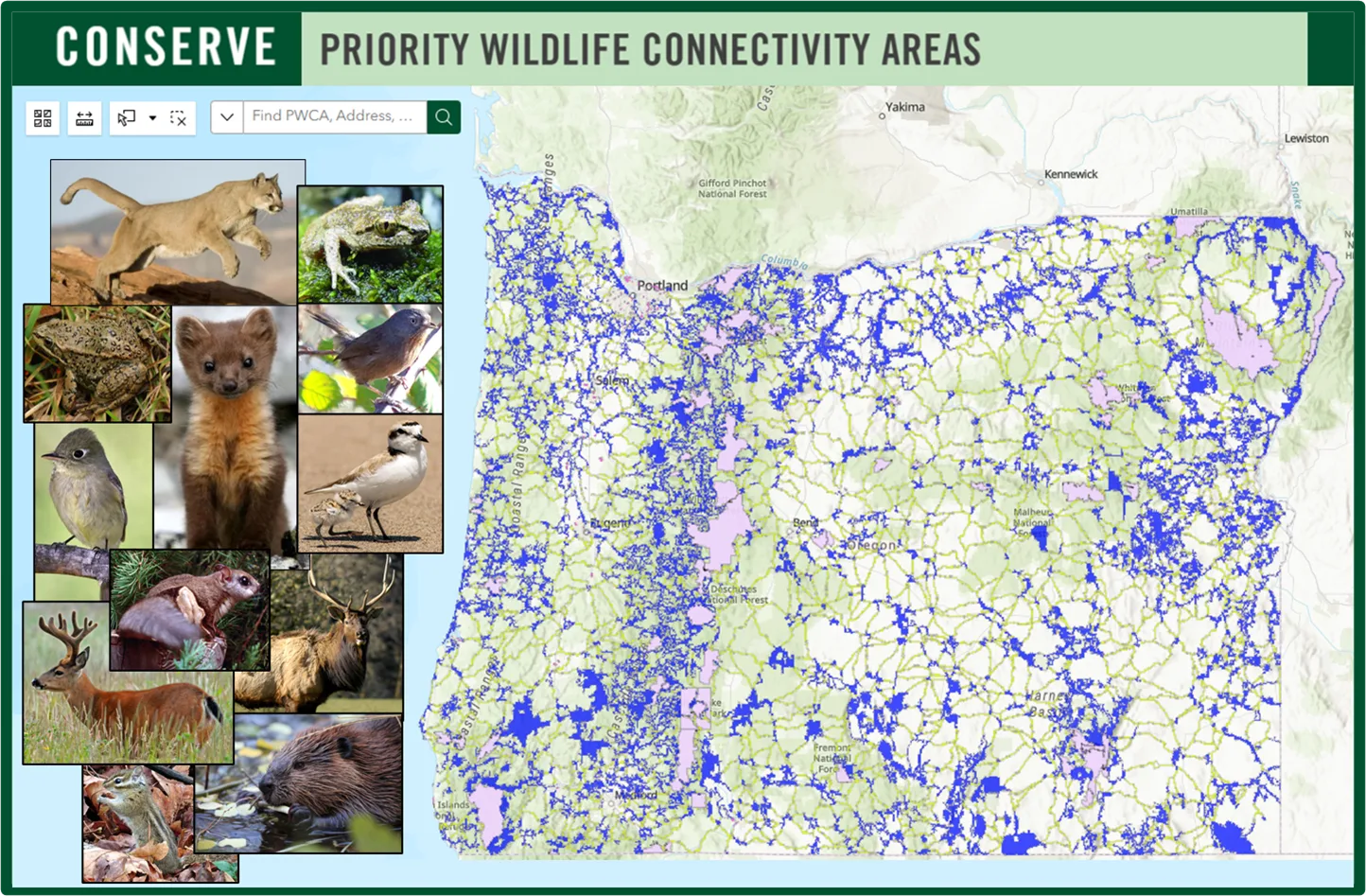
Abstract photo. A collection of pictures show the wildlife selected that are specific to, or overlap with, the Coast Range ecoregion. These species were selected using the GBSS approach. The map of Oregon shows the final product of the connectivity mapping process, referred to as Priority Wildlife Connectivity Areas, for the entire state. Photo credits: Pacific-Slope Flycatcher by Brian E. Small, Cougar by Avalon/UIG Via Getty Images, Black-Tailed Deer by Peter Davis/USFWS, Coastal Marten by Oregon State University, Coastal Tailed Frog by Brome McCreary/USGS-FRESC, Roosevelt Elk by Jim Yuskavitch, Wrentit by Martyne Reesman/ODFW, Snowy Plover by Mick Thompson, Northern Flying Squirrel by Jim Collins/ODFW, Townsend’s Chipmunk by Stephanie Savenkoff.
Abstract
The effectiveness of a landscape in providing habitat connectivity varies among species, particularly those of differing habitat affiliations and mobility types. Given limited resources, conservation planning efforts are restricted to a subset of species. Using a surrogate species approach to support connectivity planning can identify species that represent the needs of the larger ecological community. It has been common practice in connectivity planning and mapping to use habitat generalists or umbrella species as surrogates. Research suggests that these types of species typically function as poor representatives, and may not encompass the connectivity needs of a broader diversity of wildlife. We propose a process to guide the selection of a suite of surrogate species for connectivity planning and assessment that is based on diverse habitat needs and should better represent the breadth of connectivity needs for an array of taxa. We also provide an example application of the process. Steps include: 1) clarification and articulation of project goals; 2) acquisition of data to prepare for analysis; 3) hierarchical cluster analysis to group species based on habitat associations; 4) refinement of species clusters; 5) feedback from species experts and/or literature to evaluate candidates; and 6) final species selections. We identify opportunities for partner participation and local expert input throughout the selection process to broaden awareness of the project and include diverse perspectives. This Goals-Based Species Selection process allows for a greater variety of species to be selected to better represent connectivity and conservation needs, and is coupled with partner engagement and participation with the aim of increasing the likelihood of effective collaborative conservation action.
Keywords: connectivity conservation, conservation planning, focal species, habitat connectivity, partner engagement, surrogate species, wildlife corridors, wildlife movement
Introduction
Preserving and reestablishing habitat connectivity, the ability of organisms and their genetic material to move among their populations and potential habitats (Butler et al., 2021), ranks as one of the key immediate challenges for maintaining wildlife diversity, given extensive global land use change, habitat fragmentation, and climate change (Heller and Zavaleta, 2009, Worboys, 2010, Littlefield et al., 2019). Wildlife require the ability to move across the landscape to access resources and conspecifics (Theobald et al., 1997, Forman et al., 2003, Lindenmayer and Fischer, 2006, van der Ree et al., 2015). The distance and frequency of movement needs are species-specific. For example, the relatively sedentary movements of a torrent salamander will vary greatly from those of a long-distance migratory bird, daily movements might differ from seasonal movements, and these movements might differ from dispersal movements or inter-generational shifts (Cushman, 2006). Species movements can be limited by the presence and distribution, and threshold of tolerance for, barriers, including infrastructure (e.g., roads, powerlines, and development), anthropogenic habitats (e.g., agriculture, managed forests, urban neighborhoods), and even natural areas that do not function as habitat for the species in question (e.g., prairie to an exclusive forest species; Ricketts, 2001, Forman et al., 2003, Lindenmayer and Fischer, 2006). The degree to which these barriers limit movement varies across species (Taylor et al., 1993, Rytwinski and Fahrig, 2012, Jacobson et al., 2016) and life history processes (e.g., Keeley et al., 2017), meaning that conservation efforts designed to broadly address habitat connectivity require strategic approaches that can effectively account for variable species responses.
Accomplishing this goal requires the engagement and participation of a diversity of partners and decision-makers at a range of geographic and organizational scales, especially in areas where there are no policies in place to require protection of connectivity when land use changes. Here, we propose an inclusive goals-based approach to identify species for habitat connectivity planning by using project goals to drive species selection in a transparent and tractable way that, in addition, allows for partner engagement opportunities throughout the process.
It is infeasible to model movements and create species-specific landscape connectivity plans for every species. Accordingly, connectivity modeling must be restricted to a subset of species that represent the needs of the larger ecological community, such as with a surrogate species approach (Weins et al., 2008, Cushman and Landguth, 2012, USFWS, 2014a, Jones et al., 2016, Diniz et al., 2018). This term is inclusive of several categories of species, such as umbrella, indicator, focal, keystone, and others that also narrow the focus of species selections to support specific conservation objectives (Caro, 2010).
However, the application of a single one of these surrogate species categories (e.g., ‘umbrella’) can prohibit practitioners from considering species that may meet project objectives better but are not part of that category. For example, umbrella species, theorized as “species with such demanding habitat requirements and large area requirements that saving it will automatically save many other species” (Simberloff, 1998) have limited effectiveness as surrogates in real world scenarios (Ozaki et al., 2006, Seddon and Leech, 2008, Cushman and Landguth, 2012, Jones et al., 2016, Diniz et al., 2018, Meurant et al., 2018, Wang et al., 2021), often because they utilize too wide a variety of habitat types and features to consistently represent other species with more specific needs (e.g., Costanza et al., 2020). Similarly, focal species, often economically valuable species or species of greatest social interest, are typically not representative of the most sensitive connectivity needs of the broader wildlife community (Andelman and Fagan, 2000, Roberge and Angelstam, 2004, Norvell et al., 2014). Umbrella and focal species have also been found to poorly represent habitat conservation needs for the larger wildlife community when fragmentation patterns and the amount of available habitat varies across the landscape (Jones et al., 2016, Diniz et al., 2018). The larger the scale of application for connectivity modeling and planning, the lower the likelihood that fragmentation patterns and available habitat will be held constant, necessitating an alternative species selection approach.
A recurring recommendation for improvement on the use of umbrella and/or focal species is to select a greater variety of species to better represent connectivity needs (Keinath et al., 2017, Meurant et al., 2018, Brennan et al., 2020, Deere et al., 2024, Penjor et al., 2024), especially in areas with greater anthropogenic influence (Dutta et al., 2023). Powerful modeling exercises have been suggested to generate connectivity networks for all species inhabiting a given area to identify which would be the best surrogates (e.g., Dutta et al., 2023). However, the information needed to support such intensive modeling is lacking for many taxa and regions, and social prejudice against potential surrogates, such as species that may be viewed as economic pests, may hinder any connectivity conservation efforts based on the use of those species as surrogates. What seems to be missing is a feasible process to select species that will represent both diverse habitats and connectivity among habitat patches, including connectivity across multiple habitat types, and a broad range of taxonomic groups that might be data deficient. Moreover, the process must be inclusive of managers and other stakeholders, particularly those who may be using the subsequent connectivity maps.
Here, we propose a methodology for selecting species based on the habitat and landscape characteristics upon which species depend, rather than the amount of area they require (umbrella), sensitivity to a given threat (focal), or intensive efforts to model habitat needs for all species, to provide a better, more tractable way to model, map, and plan for habitat and ecological connectivity (sensu Fischer and Lindenmayer, 2007). We argue that the most appropriate suite of surrogates for representing a community’s ecological connectivity needs includes species that represent a range of movement abilities and that use specific habitats, a diversity of vegetation types, and a range of patch sizes.
Models of habitat connectivity are intended to support management, policy, or other collaborative action to preserve and enhance connectivity across the landscape, often at regional, statewide, or larger scales. However, even the best models can prove ineffective in producing on-the-ground implementation without the support of multiple partners (Prell et al., 2007). In many situations, the geographic extent of connectivity planning will cross many jurisdictions and/or many individual private properties. Successful execution of on-the-ground action to protect and enhance connectivity will depend heavily on the cooperation and enthusiasm of those entities and individuals, since partners may be constrained to specific geopolitical boundaries but wildlife movement is not. Therefore, it is critical that a diversity of partners are involved and invested in habitat connectivity planning early on and that their concerns are heard and considered in the planning process (Higgins et al., 2007, Turner et al., 2016).
Assessing, mapping, and planning for habitat connectivity is a multi-dimensional problem requiring the support of many entities and individuals. Managing and preserving connectivity effectively requires a defensible, tractable process, where decision making is well documented and can be justified and adjusted with new information (Keeley et al., 2018). Ensuring that project decisions are made with clear intention and are defensible in support of project goals allows for positive outcomes for species selection, connectivity modeling, and ongoing management, and also for positive engagement with project partners and other audiences.
Goals-Based Species Selection (GBSS) Process
The Goals-Based Species Selection (GBSS) process follows a sequence of steps that structure a uniform, transparent approach for selecting a suite of species to be used to represent connectivity across the landscape. Importantly, the process also provides several points at which project leaders can engage with a diverse group of species experts and interest holders to provide feedback on the selections. Partner participation is strongly recommended throughout, particularly for steps 1 and 5.
- Clarifying and articulating project goals
- Data acquisition to prepare for analysis
- Filtering and refinement
- Hierarchical cluster analysis
- Evaluation of species in context of project goals
- Final species selections
Step 1: Clarifying and articulating project goals
This GBSS methodology begins with clearly articulating the overall connectivity goals. This step is essential because project goals guide the criteria for selection and evaluation of surrogate species. At this stage in project development, the identification of partner engagement group(s) will serve to further refine the goals of the project, for example identifying locations where land acquisitions, conservation easements, or restoration efforts could be implemented to protect and enhance habitat connectivity, or areas where solar energy development efforts should be avoided as to not disrupt current habitat connectivity. Determining the audiences of interest will support project managers in further defining project development, data acquisition, and end-use goals. Early partner involvement in the planning process can increase the likelihood of positive outcomes, identify possible conflicts, and allow identification of solutions to conflicts through collaborative engagement (IAP2, 2013). Partnership and early engagement, when executed properly, can build excitement in partners already supportive of connectivity action and planning, increase support in neutral parties, and provide a voice early in the planning process to those with different perspectives and/or concerns about the process. Addressing concerns of project partners and groups early in the planning process will strengthen outcomes and participation (Keeley et al., 2018). While not all concerns may be feasible to address, understanding partner objections early in the planning process allows project managers to articulate how the issue will be taken into consideration throughout the project. Partners will have varying capacity for participation, so flexibility may be needed in how information is shared and feedback is received. For example, holding group meetings, scheduling one-on-one conversations, resharing information through email communication, and setting flexible timelines, are strategies that can increase the likelihood of participation.
Step 2: Data acquisition to prepare for analysis
The data acquisition step is essential for species selection, allowing practitioners to match specific species with categories of interest that may help meeting project goals, such as species habitat associations. Depending on the scope and scale of the project, a comprehensive list of species in the area of interest could range in number from dozens to hundreds. Data for each species can be summarized with information on species taxonomy and life history (for example, whether the species is migratory or not, any structural habitat characteristics required for breeding, etc.) or empirical data (for example, species’ average home range size or measured dispersal distances). During data preparation, it is important that categories and classifications are applied to different species in the same way, to allow for comparisons across groups. Minimum fields recommended for data acquisition include species name, taxa, habitat associations (including life stage uses if available, i.e., distinguishing between foraging and nesting habitats), native/non-native status, and mobility type. Additional categories may be important to include in analysis depending on the project goals determined earlier.
Step 3: Filtering and refinement
Once the complete list of species and associated habitats has been compiled, species that do not meet project-specific criteria can be removed from consideration as surrogates. Criteria should be developed based on the project goals. Example criteria used for selecting surrogates may include the following:
- Species should have close year-round or seasonal associations with (most often found in or obligate to) habitats of interest. Consideration should be given to representation of breeding and/or migratory habitats if applicable
- Species should be neither very rare nor overly common in the area of interest
- Species must be native and noninvasive
Step 4: Hierarchical cluster analysis
Once the comprehensive list of species and habitat associations and any other data of interest have been compiled, they can be analyzed through hierarchical clustering into groups (Glenn, 2002). Clustering can be used to group species by habitat association. We recommend that consideration be given to species found to be strongly associated with transitional habitat types; for example, pond breeding amphibians with terrestrial adult life stages such as the Northern Red-Legged Frog (Rana aurora). Because of the use of both terrestrial and aquatic habitat types, this species can represent connectivity both within and between upland and aquatic sites. Clustering can also be done with additional fields of interest, based on overall project goals. For example, clusters could focus on habitat associations by taxa, or habitat associations and specific dispersal thresholds.
Practitioners should explore the effects of using different numbers of clusters on cluster outcomes. Exploring several numbers of groups and reviewing the resulting clusters of habitat associations and species assemblages allows practitioners to determine the minimum number of cluster groupings needed to best capture the variety of habitats and the habitat-specific representations of species groups.
Step 5: Evaluation of species in context of project goals
Once clustering is complete, the resultant clusters will indicate groups of species that are most associated with specific habitat types as well as any other factors (e.g., taxa, mobility type, etc.) that were included in the clustering process. From there, practitioners can evaluate which species within each cluster may be the most appropriate surrogates to select to both a) represent the habitat types of interest and b) meet overall project goals. Partner input can aid in evaluating clusters to identify the most suitable species from each. To best represent a diversity of species, we recommend that the selected suite of surrogates from each habitat cluster should represent a diversity of:
- Taxa (mammals, birds, amphibians, reptiles, invertebrates, or fish);
- Mobility and dispersal capabilities;
- Responses to landscape elements that are potential barriers due to a behavioral response (i.e., avoidance of roads, anthropogenic sources of noise, artificial light, presence of people and/or domestic animals);
- Different life history strategies;
- Association with different habitat structural components (seral stage, canopy layers, etc.);
- Susceptibility to different threats to persistence (such as land clearing/vegetation removal, development, road mortality, energy development/transmission lines, fire impacts, etc.).
For projects that are relatively small in scope and where local species experts are readily identified, it may be advantageous for a small group of individuals central to the project to propose a first draft of species selections from each cluster. Those compiling the draft list should consult the literature and other information applicable to the project region to support and justify the species selected from each cluster and to provide evidence that those species satisfy the project goals and requirements as determined in the preceding steps. The compiled information can then be presented to species experts familiar with the regional scope of the project and species presence and behavior in the area. Feedback and consideration for alternative species selections can be considered, in consultation with the group.
For projects that are large in scope, either in complexity or geography, and where regional species experts are not as easily identified, a slightly different approach to soliciting feedback is proposed. Following initial species filtering, a group of biologists, species experts, and other practitioners from the region can score candidate surrogate species with a shared worksheet, evaluating the project-specific filtering criteria for each species individually within each cluster (Table 1). The project-specific filtering criteria are identified and defined by the initial project goals developed in step one of the GBSS process. Once the information has been compiled for all candidate species, a workshop can be held during which interested parties can convene to evaluate the scorings, rank species within each cluster, and finalize species selection for each cluster based on the species’ suitability to satisfy the requirements outlined by the project goals. Other approaches may be useful in soliciting feedback from a dispersed group of species experts and/or relevant partners; practitioners are encouraged to utilize additional outreach techniques as appropriate.
Step 6: Final species selections
Once clusters have been evaluated and the most suitable potential surrogates from each cluster have been identified, a final list of proposed project species can be developed. Depending on the collaborative nature and scope of the project this list of proposed species may be selected by a few project managers/participants and then presented to a larger group of species experts and partners for final approval, or a larger group may be asked to collaboratively decide on final species selections.
Examples of GBSS applications
The GBSS process proposed here has been successfully applied to connectivity mapping in projects with variable geographic scale, one of which is discussed below as an example of the application of this approach to a large-scale project. This process has also been applied at a smaller scale for an urban metropolitan area (Supplemental Information). Hierarchical clustering of species and habitat associations can be done in many ways, and processes for clustering, evaluation of cluster outcomes, and species selection will likely vary based on project goals, partner involvement, and species and habitat diversity. The below case study is intended to provide just one illustrative example of how the GBSS process has been applied in practice. Regardless of variability project to project, the key benefit of utilizing the GBSS process is that it enables the user to select a greater variety of species, using the traits and characteristics of those species that are directly relevant to the conservation objectives.
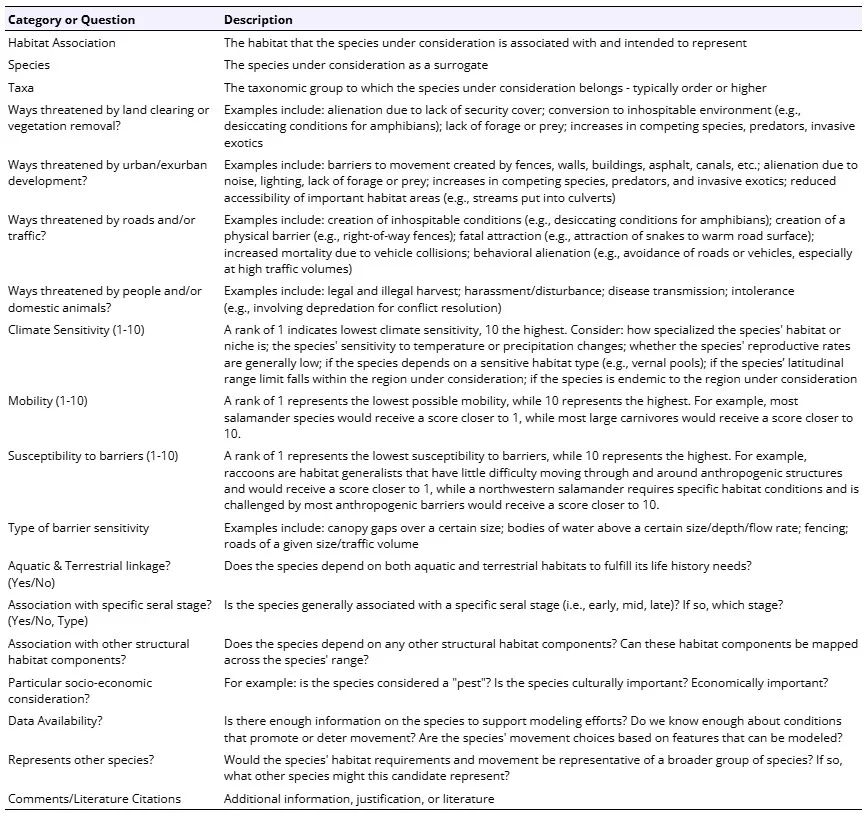
Table 1. Example Candidate Species Scoring Worksheet. Suggested worksheet categories for a shared worksheet used in participatory selection of surrogates. A group of biologists, species experts, and other practitioners from the region can rank surrogate species from this shared worksheet, evaluating the project-specific filtering criteria for each species individually. Some of the categories are scored while others are descriptive. All the categories are used to help with selection of a range of surrogates that span taxonomic groups, face a variety of threats, have a range of responses to barriers to movement, etc. In addition, information provided by partners using the worksheet can serve to elicit discussion that contributes to decision-making criteria for the selection of surrogates.
Case Study: Oregon Connectivity Assessment and Mapping Project (OCAMP)
Project description and background
Identifying priority conservation areas is a critical step in maintaining landscape connectivity across large scales and can be accomplished by generating maps using geospatial models (Baldwin et al., 2010, Spencer et al., 2010, McRae et al., 2012, WHCWG, 2012). The Oregon Connectivity and Mapping Project (OCAMP) was an initiative led by the Oregon Department of Fish and Wildlife (ODFW) in partnership with federal, state, non-profit, and university participants. This project produced connectivity maps for 54 surrogate species across Oregon, representing different taxa, habitat associations, life history strategies, and dispersal capabilities. To accomplish these goals, OCAMP worked with additional partners, end users, and other partners from each major ecoregion across the state to identify surrogate species that were used to generate connectivity maps. The following example focuses on the species selection process for the Coast Range, the first ecoregion of the state where this process was applied. Ecoregions were selected as a sub-state scale that better represents the variability in habitat types across Oregon. We replicated the process used for the Coast Range for all the other major ecoregions in the state and modeled habitat permeability and species movement statewide. The efforts in the Coast Range ecoregion were conducted in partnership with the Pacific Northwest Coast Landscape Conservation Design (LCD) initiative (PNWCLCD, 2019).
1. Articulating project goals
The goal of OCAMP was to advance priority conservation planning aimed at preventing and mitigating barriers to wildlife movement in Oregon. Through collaborative work with project partners, ODFW initiated this effort to fill critical knowledge gaps by completing connectivity assessment and mapping at fine resolution across Oregon. The goal of the initial step in this process was to select between eight and 16 surrogate species from the Coast Range ecoregion for modeling, with species representing a diversity of taxa, movement types, and sensitivities to anthropogenic threats. The desired outcome, as is often the case with these efforts, was to determine how to apply limited financial and human capital resources, while still representing connectivity needs of the broader wildlife community.
2. Data acquisition
We filtered the complete list of species and species-habitat associations in Wildlife-Habitat Relationships in Oregon and Washington (Johnson and O’Neil, 2001) to only include those species associated with habitat types found in the Coast Range. Johnson and O’Neil (2001) include the strength of association for each species-habitat relationship as well as the confidence level of that association. We ultimately considered only those species categorized as “highly associated with high confidence” with a habitat type, resulting in a list of 271 mammal, bird, reptile, and amphibian species used in the analysis.
3. Filtering and refinement of cluster results
We further refined the list of potential surrogate species by removing non-native species, marine mammals, and migratory birds that do not breed in Oregon. Non-native species and marine mammals were removed because project goals included connectivity for native, terrestrial species. Non-breeding migrants were removed (while still recognizing the need for stopover habitat) because it was thought that their local connectivity needs would be represented by a surrogate that breeds in Oregon, but not necessarily vice versa. We also removed species whose distributions had no overlap with the Coast Range ecoregion.
4. Cluster analysis
Our goal with clustering was to make sure selected surrogates could represent connectivity for the suite of species that use each of the eight major habitat types within the Coast Range, as well as movement between habitat types. We clustered species based on habitat associations using Ward’s hierarchical clustering method (Ward, 1963). For each candidate species in the region, we assigned a value of ‘1’ to a habitat type if the species was “highly associated with high confidence” (Johnson and O’Neil, 2001) and a value of ‘0’ otherwise. Clusters of species associated with each habitat type were developed in R (R Core Team, 2024) with the hclust function, using the ‘vegan’ package (Oksanen et al., 2025) to build dissimilarity matrices. We evaluated a range of potential cluster numbers for the Coast Range and ultimately selected eight groups for our cluster analysis. The selection of eight clusters aligned best with the eight predominant habitat types in the Coast Range ecoregion.
In reviewing the clustering analysis output from eight groupings, we found some groups included only a handful of species (<5) and one was composed of only a single taxon (in this case, shorebirds). Given that additional, secondary habitat associations caused a uniform group of shorebirds, this created overrepresentation of this taxonomic group for the habitat cluster. To address these small and single-taxon groupings, we elected to manually combine clusters into fewer categories after the final analysis rather than re-running the clustering algorithm. We combined small and single taxon clusters to form four habitat groups representing 1. Conifer-hardwood forests, 2. Open water, riparian, and wetlands, 3. Bays, estuaries, coastal dunes and headlands, and 4. Montane mixed conifer forest and alpine grassland and shrubland.
5. Evaluation of species in context of project goals
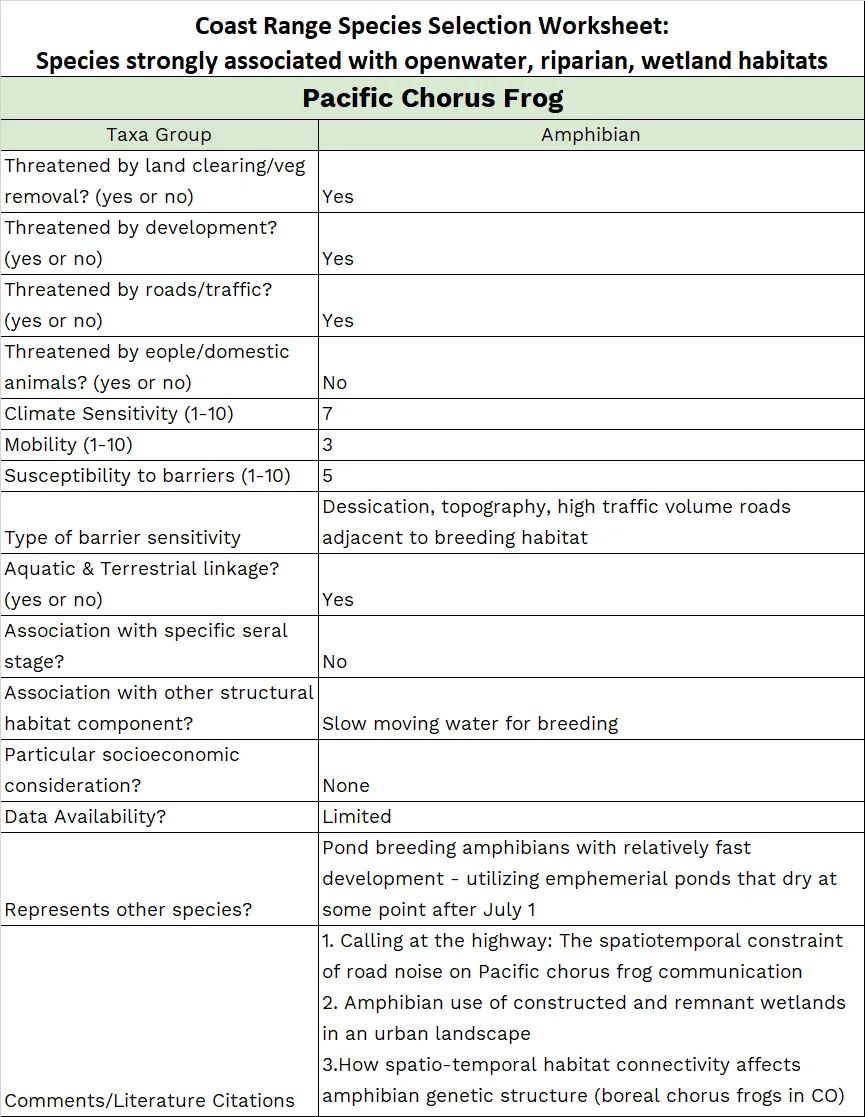
Following clustering, we developed a worksheet with species-specific fields and species grouped by habitat cluster to provide a framework for project participants to compile and compare species qualities and sensitivities (Figure 1, Figure 2). Over fifty regional species experts, including wildlife biologists, conservation non-profits, tribes, and academic professionals, among others, were invited to add information to the worksheet for species within their expertise; of those, thirteen individuals provided species information in the worksheet and an additional fourteen provided feedback in update meetings where species selections were discussed. Experts were encouraged to share the worksheet with colleagues to broaden the engagement effort. A webinar provided these species experts with background and goals of the project and guided them in contributing to the species selection process. In addition, reviewers and contributors were encouraged to include additional species for consideration if they felt a particular feature or taxon was not adequately represented in the original list.
The worksheet served multiple purposes. It provided the experts a chance to review the candidate species and suggest new candidates given the regional priorities. It also helped gather local information about the species to help us determine the best surrogates. For example, we used information provided by experts about data availability to help break ties between two potential surrogates from one cluster. Additionally, experts provided information on which species were locally considered pests, which allowed us to reconsider and evaluate whether an alternative species in a given cluster could similarly serve as an appropriate surrogate.
6. Final selections
The core project team used the completed worksheet to select a draft final list of surrogates for the ecoregion. We then held a workshop with the core team and species experts who provided feedback and continued discussion on the suitability of the proposed surrogates to represent habitats, habitat features, and project goals. The list of the most suitable suite of surrogate species selected from each habitat cluster was finalized by group consensus. Ultimately, these selected species were used to model habitat connectivity across their respective ranges in the state (following procedures in de Rivera et al., 2022).
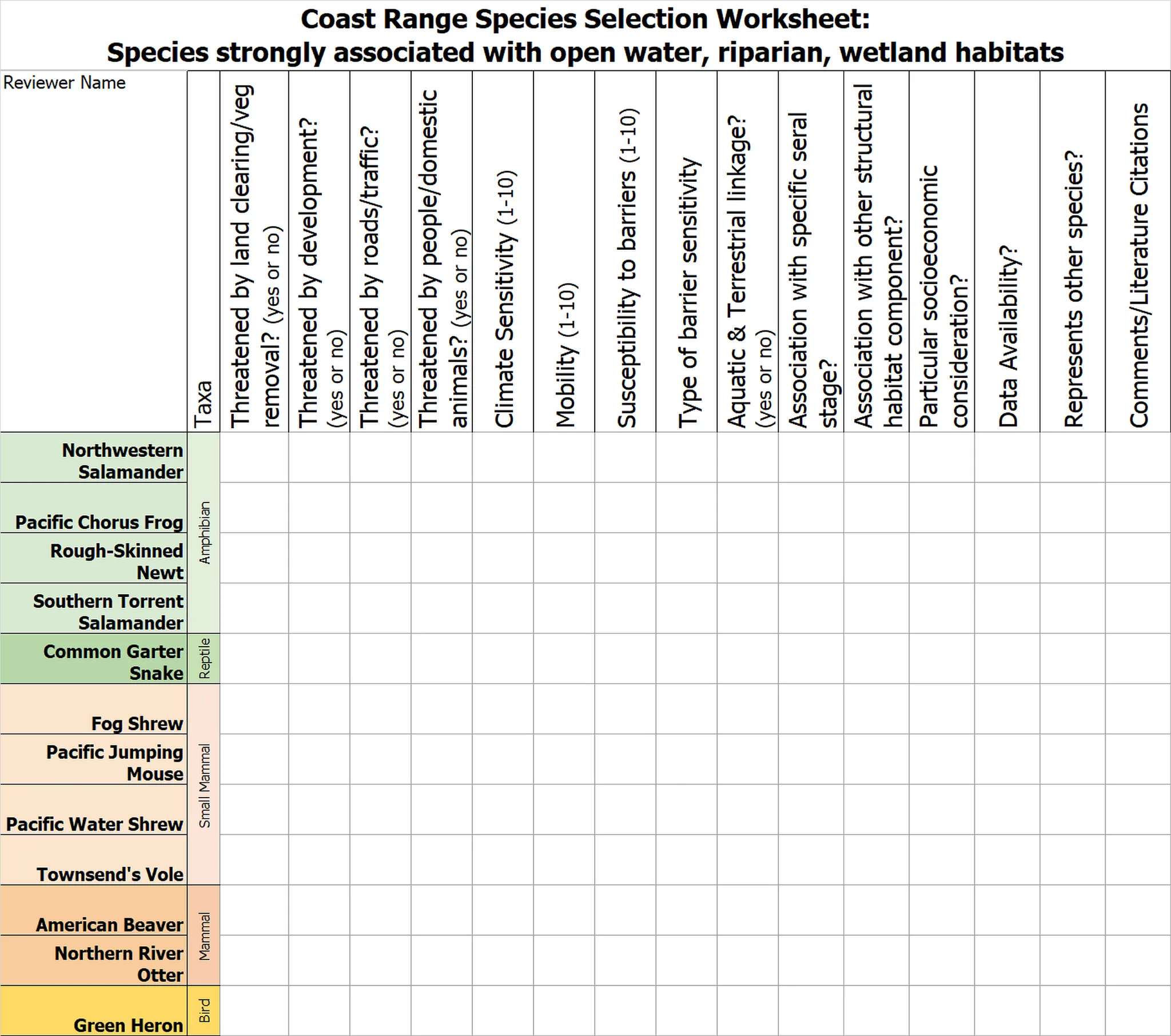
Figure 1. Species Information Worksheet. This table shows questions and associated species for one habitat grouping in the Coast Range ecoregion, (Open water, riparian, and wetlands). Color coding quickly communicates the taxonomic grouping of the species in question. See Table 1 for more information on the categories.
Discussion
The Goals-Based Species Selection approach asks practitioners to focus on project goals throughout the process of selecting and reviewing species for use in connectivity planning. These project-driven objectives are then used to create and refine a list of surrogate species. Research reveals a lack of support for any one categorization of surrogates (e.g., Seddon and Leech, 2008, Meurant et al., 2018). One of the strengths of the GBSS process is that it enables the user to select a greater variety of species, using the traits and characteristics of those species that are specific to the conservation objectives rather than stressing the importance of how species are categorized as surrogates (e.g., ‘focal’ or ‘umbrella’). We suggest that a suite of surrogates selected based on project goals will better represent habitat connectivity for a larger set of species on the landscape than species selected solely because they are of conservation concern or because of data availability (e.g., Seddon and Leech, 2008, Breckheimer et al., 2014). Transparency in the process aims to allow for better tracking and justification for decision-making in species selections. Following species selection in this way, the products generated through modeling and planning efforts can also be more directly assessed in their likelihood to advance project goals.
In addition to the benefits of better tracking and justification for decision-making in species selections, this approach facilitates engagement with project partners at multiple stages in the process, which can help garner local buy-in for the project (Higgins et al., 2007, Turner et al., 2016, Madliger et al., 2017). This engagement also increases the likelihood that data that may not otherwise be widely known about or available will not be overlooked (Wedemeyer-Strombel et al., 2019). Early engagement can promote agreement and common terminology, helping ensure that partners have the same vision for project outcomes (Meredith et al., 2018). Through soliciting input and review of species selections, inviting other professionals and partners to engage with the process, and providing these and other interested parties with project updates, the GBSS process promotes an increased awareness of the project as it is under development. The partner participation inherent in the GBSS process aims to not only leverage local knowledge, so the most appropriate species are selected as surrogates, but also to increase acceptance and support of the process and improve the likelihood that the resulting products will be used.
Given the flexibility inherent in this approach, GBSS can be applied to other contexts and conservation applications. For example, this process can be applied to smaller-scale connectivity mapping projects in a variety of regions, including urban areas. In applying this method in urban areas, additional considerations may be necessary. For example, species selection criteria may need to account for species sensitivity to (or adaptation for) disturbance and development. The GBSS process has been successfully utilized in selecting species for connectivity mapping in the Portland metropolitan area of Oregon (see Supplemental Information for details). Additionally, the GBSS approach could be applied beyond connectivity modeling, for example to develop protocols for biodiversity monitoring in cities. Selection of surrogate species has been proposed by The Urban Biodiversity Inventory Framework to best use limited financial and human capital resources for long-term, cross-taxa monitoring of biodiversity in cities (USDN, 2017).
Multi-species conservation efforts are inherently complex and challenging. However, we suggest that a focus on process and engagement will allow groups to better address conservation goals and to overcome shortcomings of approaches aimed at a single surrogate species or even a single category of surrogates (Seddon and Leech, 2008, Cushman and Landguth, 2012, Jones et al., 2016, Meurant et al., 2018, Brennan et al., 2020). No matter which procedures are undertaken to model habitat connectivity, the outlined replicable, transparent, and inclusive process of selecting surrogates should enable planning that represents potential movement for a region’s animals and ensures improved partner buy-in.
Acknowledgments
Special thanks for additional project support and feedback from: T. Miewald, A. Temple, A. Hanson, A. Rodriguez, S. Eppley, D. Taylor-Rodriguez
Author Contributions
Leslie L. Bliss-Ketchum: Conceptualization, Data Curation, Formal Analysis, Investigation, Methodology, Project Administration, Visualization, Writing
Catherine E. de Rivera: Conceptualization, Investigation, Methodology, Literature Review, Writing, Funding Acquisition
Rachel E. Wheat: Formal Analysis, Funding Acquisition, Investigation, Methodology, Project Administration, Supervision, Writing
Martin Lafrenz: Formal analysis, Methodology, Visualization, Writing
Lori Hennings: Conceptualization, Methodology
Data Availability
The data and code for this article can be found here.
Supplementary Information
Supplementary information can be found here.
Transparent Peer Review
Results from the Transparent Peer Review can be found here.
Recommended Citation
Bliss-Ketchum, L., C. E. de Rivera, R. E. Wheat, M. Lafrenz, and L. Hennings. 2026. Goals-based species selection process for connectivity modeling and planning. Stacks Journal: 26006. https://doi.org/10.60102/stacks-26006
References
Andelman, S. J., and W. F. Fagan. 2000. Umbrellas and flagships: efficient conservation surrogates or expensive mistakes? Proceedings of the National Academy of Sciences 97: 5954–5959. https://doi.org/10.1073/pnas.100126797.
Armstrong, D. 2002. Focal and surrogate species: getting the language right. Conservation Biology 16: 285–286. https://doi.org/10.1046/j.1523-1739.2002.00109.x.
Baldwin, R. F., R. M. Perkl, S. C. Tombulak, and W. B. Burwell. 2010. Modeling ecoregional connectivity. In Landscape-Scale Conservation Planning, edited by S. C. Tombulak and R. F. Baldwin, 349–367. Netherlands: Springer. https://doi.org/10.1007/978-90-481-9575-6_16.
Banks, J. E., J. D. Stark, R. I. Vargas, and A. S. Ackleh. 2014. Deconstructing the surrogate species concept: a life history approach to the protection of ecosystem services. Ecological Applications 24: 770–778. https://doi.org/10.1890/13-0937.1.
Bliss-Ketchum, L. L., R. J. Littlejohn, J. Riehl, M. Hepner, and A. Escobedo-Land. 2017. Urban Biodiversity Inventory Framework. Samara Group.
Breckheimer, I. A. N., N. M. Haddad, W. F. Morris, A. M. Trainor, W. R. Fields, R. T. Jobe, B. R. Hudgens, A. Moody, and J. R. Walters. 2014. Defining and evaluating the umbrella species concept for conserving and restoring landscape connectivity. Conservation Biology 28: 1584–1593. https://doi.org/10.1111/cobi.12362.
Brennan, A., P. Beytell, O. Aschenborn, P. du Preez, P. J. Funston, L. Hanssen, J. W. Kilian, G. Stuart-Hill, R. D. Taylor, and R. Naidoo. 2020. Characterizing multispecies connectivity across a transfrontier conservation landscape. Journal of Applied Ecology 57: 1700–1710. https://doi.org/10.1111/1365-2664.13716.
Butler, E. P., L. L. Bliss-Ketchum, C. E. de Rivera, S. T. Dissanayake, C. L. Hardy, D. A. Horn, B. Huffine, A. M. Temple, M. E. Vermeulen, and H. Wallace. 2021. Habitat, geophysical, and eco-social connectivity: benefits of resilient socio-ecological landscapes. Landscape Ecology 37: 1–29. https://doi.org/10.1007/s10980-021-01339-y.
Caro, T. 2002. Focal and surrogate species: getting the language right. Conservation Biology 16: 286–287. https://doi.org/10.1046/j.1523-1739.2002.00111_16_2.x.
Caro, T. 2010. Conservation by Proxy: Indicator, Umbrella, Keystone, Flagship, and Other Surrogate Species. Washington, DC: Island Press.
Costanza, J. K., J. Watling, R. Sutherland, C. Belyea, B. Dilkina, H. Cayton, D. Bucklin, S. S. Romañach, and N. M. Haddad. 2020. Preserving connectivity under climate and land-use change: no one-size-fits-all approach for focal species in similar habitats. Biological Conservation 248: 108678. https://doi.org/10.1016/j.biocon.2020.108678.
Cushman, S. A. 2006. Effects of habitat loss and fragmentation on amphibians: a review and prospectus. Biological Conservation 128: 231–240. https://doi.org/10.1016/j.biocon.2005.09.031
Cushman, S. A., and E. L. Landguth. 2012. Multi-taxa population connectivity in the northern Rocky Mountains. Ecological Modelling 231: 101–112. https://doi.org/10.1016/j.ecolmodel.2012.02.011.
Csuti, B., T. A. O’Neil, M. M. Shaughnessy, E. P. Gaines, and J. C. Hak. 2001. Atlas of Oregon Wildlife: Distribution, Habitat, and Natural History. 2nd ed. Corvallis: Oregon State University Press.
de Rivera, C. E., L. L. Bliss-Ketchum, M. D. Lafrenz, A. V. Hanson, L. E. McKinney-Wise, A. H. Rodriguez, J. Schultz, A. L. Simmons, D. Taylor Rodriguez, A. H. Temple, and R. E. Wheat. 2022. Visualizing connectivity for wildlife in a world without roads. Frontiers in Environmental Science 10:757954. https://doi.org/10.3389/fenvs.2022.757954.
Deere, N. J., E. Ramadiyanta, M. C. Sibarani, A. N. Hadi, N. Andayani, Y. Ginting, J. W. Bull, and M. J. Struebig. 2024. Selecting umbrella species as mammal biodiversity indicators in tropical forest. Biological Conservation 292: 110511. https://doi.org/10.1016/j.biocon.2024.110511.
Diniz, M. F., R. B. Machado, A. A. Bispo, and P. M. Junior. 2018. Can we face different types of storms under the same umbrella? Efficiency and consistency of connectivity umbrellas across different patchy landscape patterns. Landscape Ecology 33: 1911–1923. https://doi.org/10.1007/s10980-018-0720-2.
Dutta, T., M. De Barba, N. Selva, A. C. Fedorca, L. Maiorano, W. Thuiller, A. Zedrosser, J. Signer, F. Pflüger, S. Frank, and P. M. Lucas. 2023. An objective approach to select surrogate species for connectivity conservation. Frontiers in Ecology and Evolution 11: 1078649. https://doi.org/10.3389/fevo.2023.1078649.
Ferraz, G., G. J. Russell, P. C. Stouffer, R. O. Bierregaard Jr., S. L. Pimm, and T. E. Lovejoy. 2003. Rates of species loss from Amazonian forest fragments. Proceedings of the National Academy of Sciences 100: 14069–14073. https://doi.org/10.1073/pnas.2336195100.
Fischer, J., and D. B. Lindenmayer. 2007. Landscape modification and habitat fragmentation: a synthesis. Global Ecology and Biogeography 16: 265–280. https://doi.org/10.1111/j.1466-8238.2007.00287.x.
Fleishman, E., D. D. Murphy, and P. F. Brussard. 2000. A new method for selection of umbrella species for conservation planning. Ecological Applications 10: 569–579. https://doi.org/10.1890/1051-0761(2000)010[0569:ANMFSO]2.0.CO;2.
Forman, R. T., D. Sperling, D. Bissonette, J. A. Clevenger, A. P. Cutshall, D. Dale, V. H. Dale, L. Fahrig, R. L. France, C. R. Goldman, K. Heanue, J. Jones, F. Swanson, T. Turrentine, and T. C. Winter. 2003. Road Ecology: Science and Solutions. Washington, DC: Island Press.
Hatfield, J. H., C. D. L. Orme, J. A. Tobias, and C. Banks-Leite. 2018. Trait-based indicators of bird species sensitivity to habitat loss are effective within but not across data sets. Ecological Applications 28: 28–34. https://doi.org/10.1002/eap.1646.
Heller, N. E., and E. S. Zavaleta. 2009. Biodiversity management in the face of climate change: a review of 22 years of recommendations. Biological Conservation 142: 14–32. https://doi.org/10.1016/j.biocon.2008.10.006.
Higgins, A., K. Serbesoff-King, M. King, and K. O’Reilly-Doyle. 2007. The power of partnerships: landscape scale conservation through public/private collaboration. Natural Areas Journal 27: 236–250. https://doi.org/10.3375/0885-8608(2007)27[236:TPOPLS]2.0.CO;2.
International Association for Public Participation (IAP2). 2013. IAP2 Spectrum of Public Participation. https://icma.org/sites/default/files/305432_IAP2%20Spectrum%20of%20Public%20Participation.pdf.
The Intertwine Alliance. 2012a. Regional Conservation Strategy for the Greater Portland–Vancouver Region. Edited by A. Sihler. Portland, OR: The Intertwine Alliance.
The Intertwine Alliance. 2012b. Biodiversity Guide for the Greater Portland–Vancouver Region. Edited by A. Sihler. Portland, OR: The Intertwine Alliance.
Johnson, D. H., and T. A. O’Neil. 2001. Wildlife-Habitat Relationships in Oregon and Washington. Corvallis, Oregon. Oregon State University Press.
Jones, K. R., A. J. Plumptre, J. E. M. Watson, H. A. Possingham, S. Ayebare, A. Rwetsiba, F. Wanyama, D. Kujirakwinja, and C. J. Klein. 2016. Testing the effectiveness of surrogate species for conservation planning in the Greater Virunga Landscape, Africa. Landscape and Urban Planning 145: 1–11. https://doi.org/10.1016/j.landurbplan.2015.09.006.
Keeley, A. T. H., P. Beier, B. W. Keeley, and M. E. Fagan. 2017. Habitat suitability is a poor proxy for landscape connectivity during dispersal and mating movements. Landscape and Urban Planning 161: 90–102. https://doi.org/10.1016/j.landurbplan.2017.01.007.
Keeley, A. T. H., G. D. Basson, R. Cameron, N. E. Heller, P. R. Huber, C. A. Schloss, J. H. Thorne, and A. M. Merenlender. 2018. Making habitat connectivity a reality. Conservation Biology 32: 1221–1232. https://doi.org/10.1111/cobi.13158.
Keinath, D. A., D. F. Doak, K. E. Hodges, L. R. Prugh, W. Fagan, C. H. Şekercioğlu, S. H. M. Butchart, and M. Kauffman. 2017. A global analysis of traits predicting species sensitivity to habitat fragmentation. Global Ecology and Biogeography 26: 115–127. https://doi.org/10.1111/geb.12509.
Krosby, M., I. Breckheimer, D. J. Pierce, P. H. Singleton, S. A. Hall, K. C. Halupka, W. L. Gaines, R. A. Long, B. H. McRae, B. L. Cosentino, and J. P. Schuett-Hames. 2015. Focal species and landscape naturalness corridor models offer complementary approaches for connectivity conservation planning. Landscape Ecology 30: 2121–2132. https://doi.org/10.1007/s10980-015-0235-z.
Lindenmayer, D. B., and J. Fischer. 2006. Habitat Fragmentation and Landscape Change: An Ecological and Conservation Synthesis. Washington, DC. Island Press.
Littlefield, C. E., M. Krosby, J. L. Michalak, and J. J. Lawler. 2019. Connectivity for species on the move: supporting climate-driven range shifts. Frontiers in Ecology and the Environment 17: 270–278. https://doi.org/10.1002/fee.2043.
Madliger, C. L., C. E. Franklin, K. R. Hultine, M. van Kleunen, R. J. Lennox, O. P. Love, J. L. Rummer, and S. J. Cooke. 2017. Conservation physiology and the quest for a good Anthropocene. Conservation Physiology 5: cox003. https://doi.org/10.1093/conphys/cox003.
McRae, B. H., S. A. Hall, P. Beier, and D. M. Theobald. 2012. Where to restore ecological connectivity? Detecting barriers and quantifying restoration benefits. PLOS ONE 7: e52604. https://doi.org/10.1371/journal.pone.0052604.
Meredith, H. M. R., F. A. V. St. John, B. Collen, S. A. Black, and R. A. Griffiths. 2018. Practitioner and scientist perceptions of successful amphibian conservation. Conservation Biology 32: 366–375. https://doi.org/10.1111/cobi.13005.
Meurant, M., A. Gonzalez, A. Doxa, and C. H. Albert. 2018. Selecting surrogate species for connectivity conservation. Biological Conservation 227: 326–334. https://doi.org/10.1016/j.biocon.2018.09.028.
Norvell, R. E., T. C. Edwards Jr., and F. P. Howe. 2014. Habitat management for surrogate species has mixed effects on non-target species in the sagebrush steppe. Journal of Wildlife Management 78: 456–462. https://doi.org/10.1002/jwmg.680.
Oksanen, J., et al. 2025. vegan: Community Ecology Package. R package version 2.7-1. https://CRAN.R-project.org/package=vegan.
Ozaki, K., M. Isono, T. Kawahara, S. Iida, T. Kudo, and K. Fukuyama. 2006. A mechanistic approach to evaluation of umbrella species as conservation surrogates. Conservation Biology 20: 1507–1515. https://doi.org/10.1111/j.1523-1739.2006.00444.x.
Pacific Northwest Coast Landscape Conservation Design (PNWCLCD). 2019. A blueprint for a climate resilient landscape in the Lower Columbia and outer coasts of Oregon and Washington. http://columbiacoastblueprint.org/.
Penjor, U., Z. M. Kaszta, D. W. Macdonald, and S. A. Cushman. 2024. Identifying umbrella and indicator species to support multispecies population connectivity in a Himalayan biodiversity hotspot. Frontiers in Conservation Science 5: 1306051. https://doi.org/10.3389/fcosc.2024.1306051.
Prell, C., K. Hubacek, M. Reed, C. Quinn, N. Jin, J. Holden, and J. Sendzimir. 2007. If you have a hammer everything looks like a nail: traditional versus participatory model building. Interdisciplinary Science Reviews 32: 263–282. https://doi.org/10.1179/030801807X211720.
R Core Team. 2024. R: A language and environment for statistical computing. Vienna: R Foundation for Statistical Computing. https://www.R-project.org/.
Ricketts, T. H. 2001. The matrix matters: effective isolation in fragmented landscapes. The American Naturalist 158: 87–99. https://doi.org/10.1086/320863.
Roberge, J., and P. Angelstam. 2004. Usefulness of the umbrella species concept as a conservation tool. Conservation Biology 18: 76–85. https://doi.org/10.1111/j.1523-1739.2004.00450.x.
Rytwinski, T., and L. Fahrig. 2012. Do species life history traits explain population responses to roads? A meta-analysis. Biological Conservation 147: 87–98. https://doi.org/10.1016/j.biocon.2011.11.023.
Seddon, P. J., and T. Leech. 2008. Conservation shortcut, or long and winding road? A critique of umbrella species criteria. Oryx 42: 240–245. https://doi.org/10.1017/S003060530806119X.
Simberloff, D. 1998. Flagships, umbrellas, and keystones: is single-species management passé in the landscape era? Biological Conservation 83: 247–257. https://doi.org/10.1016/S0006-3207(97)00081-5.
Spencer, W. D., P. Beier, K. Penrod, K. Winters, C. Paulman, H. Rustigian-Romsos, J. Strittholt, M. Parisi, and A. Pettler. 2010. California essential habitat connectivity project: a strategy for conserving a connected California. Prepared for California Department of Transportation.
Stoffyn-Egli, P., and J. H. Martin Willison. 2011. Including wildlife habitat in the definition of riparian areas: the beaver (Castor canadensis) as an umbrella species for riparian obligate animals. Environmental Reviews 19: 479–494. https://doi.org/10.1139/a11-019.
Taylor, P. D., L. Fahrig, K. Henein, and G. Merriam. 1993. Connectivity is a vital element of landscape structure. Oikos: 571–573. https://doi.org/10.2307/3544927.
Turner, B. L., K. J. Esler, P. Bridgewater, J. Tewksbury, N. Sitas, B. Abrahams, F. S. Chapin, R. R. Chowdhury, P. Christie, and S. Díaz. 2016. Socio-environmental systems research: what have we learned and how can we use this information in future research programs. Current Opinion in Environmental Sustainability 19: 160–168. https://doi.org/10.1016/j.cosust.2016.04.001.
Theobald, D. M., J. R. Miller, and N. T. Hobbs. 1997. Estimating the cumulative effects of development on wildlife habitat. Landscape and Urban Planning 39: 25–36. https://doi.org/10.1016/S0169-2046(97)00041-8.
Urban Sustainability Directors Network (USDN). 2017. Urban Biodiversity Inventory Framework. https://www.stlouis-mo.gov/government/departments/planning/sustainability/documents/upload/UBIF-Final-2.pdf.
U.S. Fish and Wildlife Service (USFWS). 2014a. Surrogate species. https://www.fws.gov/mountain-prairie/science/surrogate_species.cfm.
U.S. Fish and Wildlife Service (USFWS). 2014b. Strategic conservation management in Oregon’s Willamette Valley: surrogate species pilot 1.0. Portland, Oregon. https://www.fws.gov/oregonfwo/documents/SurrogateSpeciesPilot1.0.pdf.
van der Ree, R., D. J. Smith, and C. Grilo. 2015. Handbook of Road Ecology. West Sussex: John Wiley & Sons. https://doi.org/10.1002/9781118568170.
Wang, F., J. Winkler, A. Viña, W. J. McShea, S. Li, T. Connor, Z. Zhao, D. Wang, H. Yang, Y. Tang, J. Zhang, and J. Liu. 2021. The hidden risk of using umbrella species as conservation surrogates: a spatio-temporal approach. Biological Conservation 253: 108913. https://doi.org/10.1016/j.biocon.2020.108913.
Ward, J. H. 1963. Hierarchical grouping to optimize an objective function. Journal of the American Statistical Association 58: 236–244. https://doi.org/10.1080/01621459.1963.10500845.
Washington Wildlife Habitat Connectivity Working Group (WWHCWG). 2012. Washington Connected Landscapes Project: Statewide Analysis. Olympia, Washington.
Wedemeyer-Strombel, K. R., M. J. Peterson, R. N. Sanchez, S. Chavarría, M. Valle, E. Altamirano, V. Gadea, S. K. Sowards, C. E. Tweedie, and M. J. Liles. 2019. Engaging fishers’ ecological knowledge for endangered species conservation: four advantages to emphasizing voice in participatory action research. Frontiers in Communication 4: 30. https://doi.org/10.3389/fcomm.2019.00030.
Wiens, J. A., G. D. Hayward, R. S. Holthausen, and M. J. Wisdom. 2008. Using surrogate species and groups for conservation planning and management. BioScience 58: 241–252. https://doi.org/10.1641/B580310.
Worboys, G. 2010. The connectivity conservation imperative. In Connectivity Conservation Management, edited by G. Worboys, W. Francis, and M. Lockwood, 3–18. London: Earthscan. https://doi.org/10.4324/9781849774727.
Open Access
Peer-Reviewed
Accepted: 20 January 2026
Published: 29 May 2026
Funding was provided by the: Metro Regional Government of Portland, Oregon, Oregon Department of Fish and Wildlife, and United States Fish and Wildlife Service.
Conflicts of Interest:
The authors declares no conflicts of interest.


