



Invasive wild pig movement and space use in a mixed-use forest landscape, South Carolina
2 Clemson University, Department of Forestry & Environmental Conservation, Clemson, SC, USA
EKB: https://orcid.org/0000-0002-1985-9531
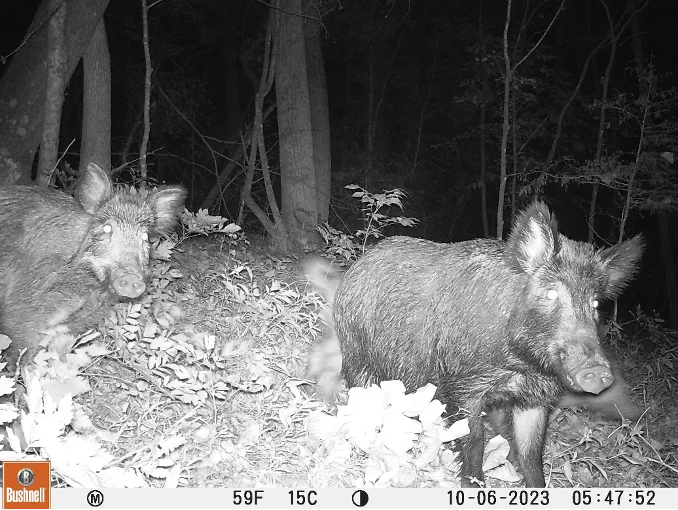
Abstract photo. Invasive wild pigs (Sus scrofa) in the study area in the Clemson University Forest, South Carolina, USA October 2023 (camera trap photo, image courtesy of E. Buchholtz).
Abstract
Invasive wild pigs (Sus scrofa) pose considerable ecological and economic challenges across their introduced range, and understanding their spatial ecology is critical for management. This research and accompanying dataset represents adult wild pig movement in South Carolina, United States based on 16 individuals collared in 2023-2024. Using hourly GPS collar data for 6 males and 5 females, we calculated autocorrelated kernel density estimates (AKDEs) and monthly kernel density estimates (KDEs) to characterize space use. Individual pigs had an average hourly step length of 83 m and average net displacement of 930 m. On average, pigs used 2.32 km2 monthly, while they used 2.95 km2 over their entire tracked period (mean = 111 days). This work aims to support management actions and future research on invasive wild pigs.
Keywords: home range, invasive species, kernel density estimation, movement ecology, Sus scrofa, wild pig
Introduction
Invasive wild pigs (Sus scrofa) pose considerable ecological and economic challenges across their introduced range. In North America, wild pigs have been introduced or spread across 28 states (Southeastern Cooperative Wildlife Disease Study, 2024), where they compete with native species (Garabedian et al., 2023), cause agricultural damage (McKee et al., 2024), and transmit diseases (Miller et al., 2017). Understanding and addressing wild pigs’ ecological, economic, and related effects is therefore a key concern for resource managers.
Location data from GPS collars provides an opportunity to gather information about wild pig spatial ecology that can inform evidence-based management. Wild pigs are adaptable generalists, and we expect individual and regional variation in how they use their environment. For example, previous work estimated wild pigs in Finland had home ranges of 33 km2 (Miettinen et al., 2023), while those in Texas, United States have reported ranges from 10.5 km2 (Froehly et al., 2020) to 48.3 km2 (Adkins and Harveston, 2007). Quantifying patterns like space use can support effective management actions, such as identifying key locations for trapping and removal or predicting areas at risk for invasion (Kramer et al., 2024). Our objective in collecting location data was to quantify space use and movement of invasive wild pigs to contribute to our understanding and management of this species.
Methods and Materials
Study area

This study took place in the Clemson University Forest, ~19,000 acres of mixed-use forestry and recreation land managed by Clemson University in northwestern South Carolina, United States (Figure 1). Topography and land cover are diverse, including pine and hardwood stands, lakes, creeks, and bottomlands, as well as wildlife management and recreation areas. Surrounding the Forest is a mix of private residential and rural properties. Invasive wild pigs have been present in this region since at least 1982 (Southeastern Cooperative Wildlife Disease Study, 1982) and in the Forest and surrounding properties for at least a decade.
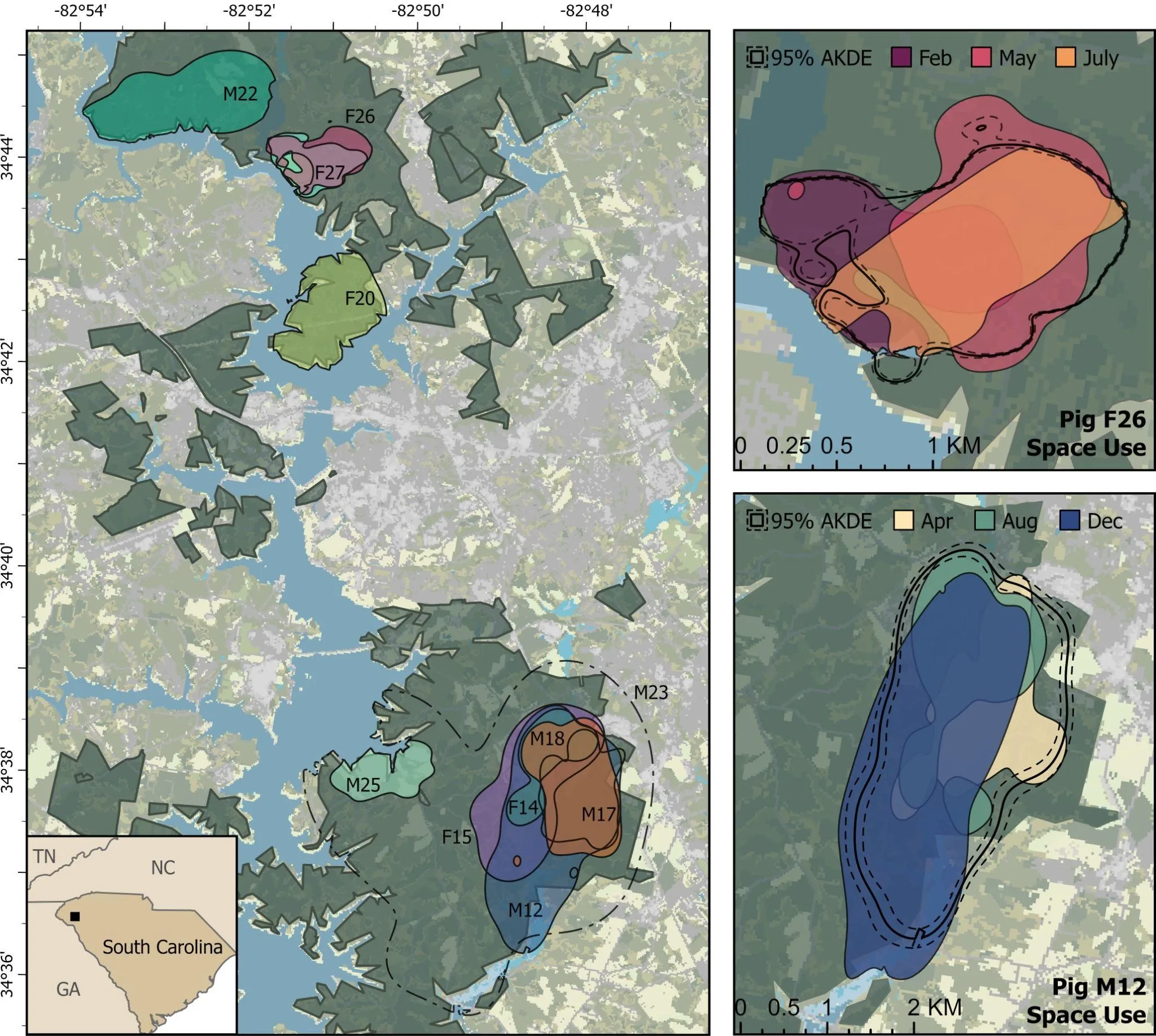
Figure 1. Left: Study area of the Clemson University Forest (dark green) in South Carolina, with space use for individual adult wild pigs (Sus scrofa) based on AKDE 95% utilizations. Note, black dashed line for M23 indicates the calculated AKDE although M23’s variogram did not indicate range residency. Right: Monthly KDE polygons illustrating temporal variation in space use overlaid with total AKDE for female pig F26 (top) and male pig M12 (bottom).
Data collection and processing
We captured 18 adult wild pigs opportunistically across the Clemson University Forest property during fall and spring 2023 and 2024 (Table 1) using a combination of net-style corral traps and existing fixed corral traps baited with dry corn. Candidate pigs for collaring were identified in the trap as those > 100 lbs, and non-candidate pigs were euthanized. Pigs were immobilized with a mixture of Telazol (R) (4.4 mg/kg) and Xylazine (2.2 mg/kg). We marked individual pigs with numbered ear tags, weighed them, and attached GPS collars (Telonics model CR-5A). If collared individuals were still immobile after collaring, we administered Atipamezole (2.0 mg/kg), and they were monitored until tranquilizer effects subsided. Collars were programmed to collect GPS locations at 1-hr intervals and detach after a maximum of 12 months. This study was conducted under Clemson University Animal Use Protocol AUP2022-0467.
We cleaned collar data by removing spatial and speed-based (> 0.4 m/s) outliers. The collars provided an estimated location error for each point, and we used this value to filter out points with > 50 m reported location error. In cases where deployment end date was uncertain, we removed locations after collar displacement consistently remained < 50 m. Two pigs were removed from the dataset entirely: one male with < 24 hours of data, and one female where GPS points were localized in a dense canopy area with transmission error that made it impossible to identify space use or movement trajectory. This cleaned, full dataset contains 13,939 GPS locations for 16 adult wild pigs (8 female, 8 male) (refer to Data Availability Statement). Collar deployment duration varied due to pig mortality and collar failure. On average, pigs were collared for about 3.5 months (mean = 110 days, range = 11 – 297 days), and 5 pigs had at least 1000 valid locations (Table 1).
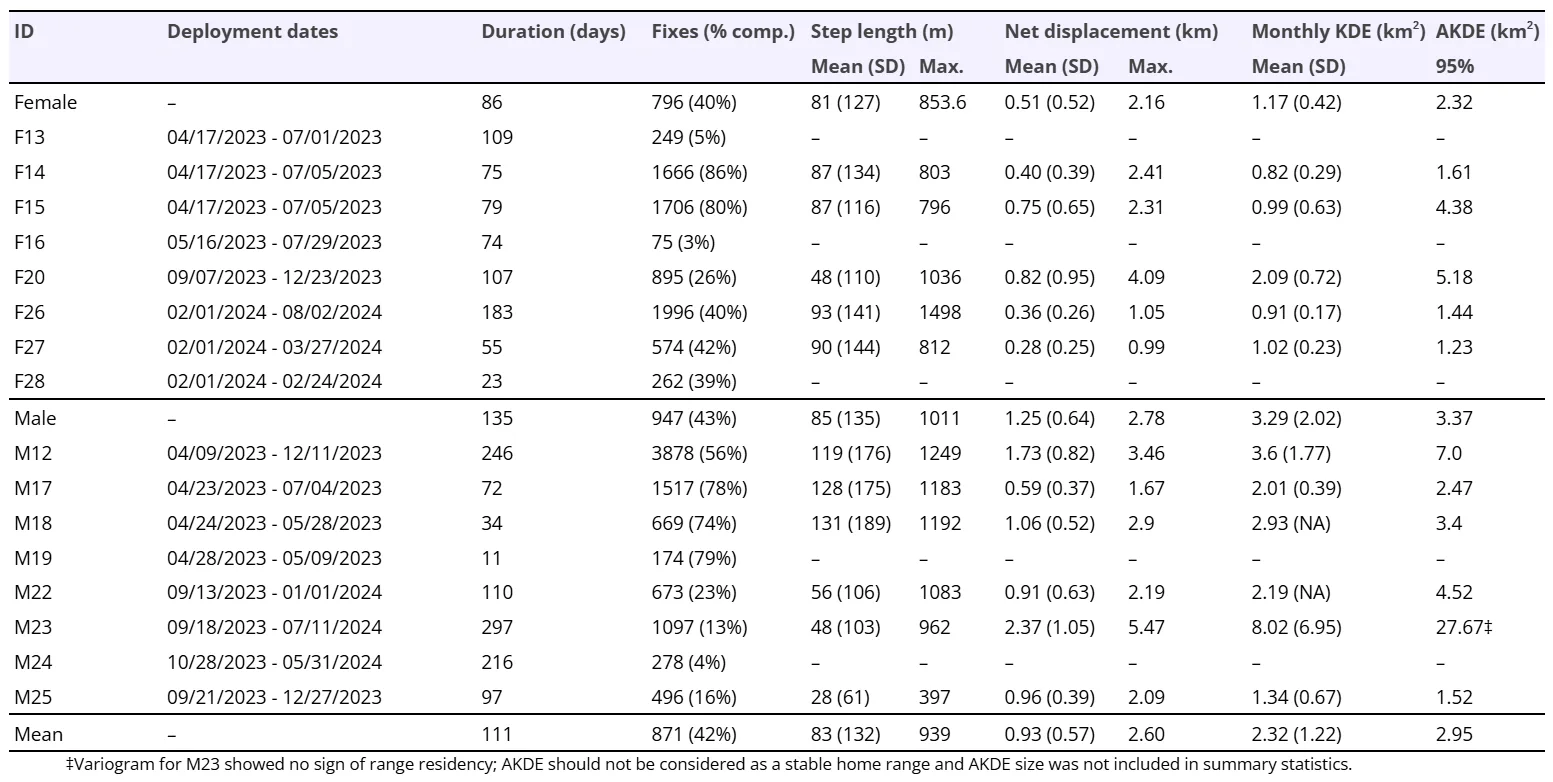
Table 1. Deployment, movement, and space use statistics calculated for wild pigs (Sus scrofa) in the Clemson University Forest between 2023 and 2024 based on GPS collar locations, calculated individually and summarized by sex. All 16 tracked pigs are listed, although movement and space use statistics were only calculated for the 6 males and 5 females that had more than 1 month of tracking and over 10% completion rate of location fixes.
Movement and space use analyses
We further subsetted the dataset for movement and space use analyses. We removed GPS locations from the first two days post-collaring to limit potential capture effects (as per Froehly et al., 2020). We used the adehabitatLT package (Calenge et al., 2023) in R (v4.3.2, R Core Team, 2023) to create trajectories, calculate the total number of GPS location fixes, and calculate the percent of completed fixes based on tracking duration and hourly rate. We then filtered the data to only include pigs that had > 30 days of tracking and > 10% completion rate (Table 1). This left us with 6 males and 5 females (12,786 fixes).
To characterize movement, we calculated step lengths and net displacement distances for each pig based on their trajectories. Step length represents the Euclidean distance between two consecutive 1-hour fixes. Net displacement was calculated as the Euclidean distance between the first location in a trajectory and each subsequent location; mean and maximum net displacement serve as measures of how far an animal moved from its starting location over the course of the trajectory.
We used the ctmm package (Calabrese et al., 2016; Fleming et al., 2023) to calculate an autocorrelated kernel density estimation (AKDE) at the 95% isopleth for each pig to characterize potential space use while accounting for autocorrelation in fix locations. Ornstein-Uhlenbeck-F anisotropic movement models were the best fit for all pigs and were used to fit the AKDEs. We examined variograms for range residency. We calculated monthly kernel density estimates (KDE) at the 95% isopleth to capture temporal variation in space use. We calculated a KDE for each pig in each month with > 100 fixes. Our study site includes lakes that are unused by pigs, so we restricted kernel estimates to exclude open water (NLCD 2019, Dewitz, 2021).
Results
Summary of movement and space use
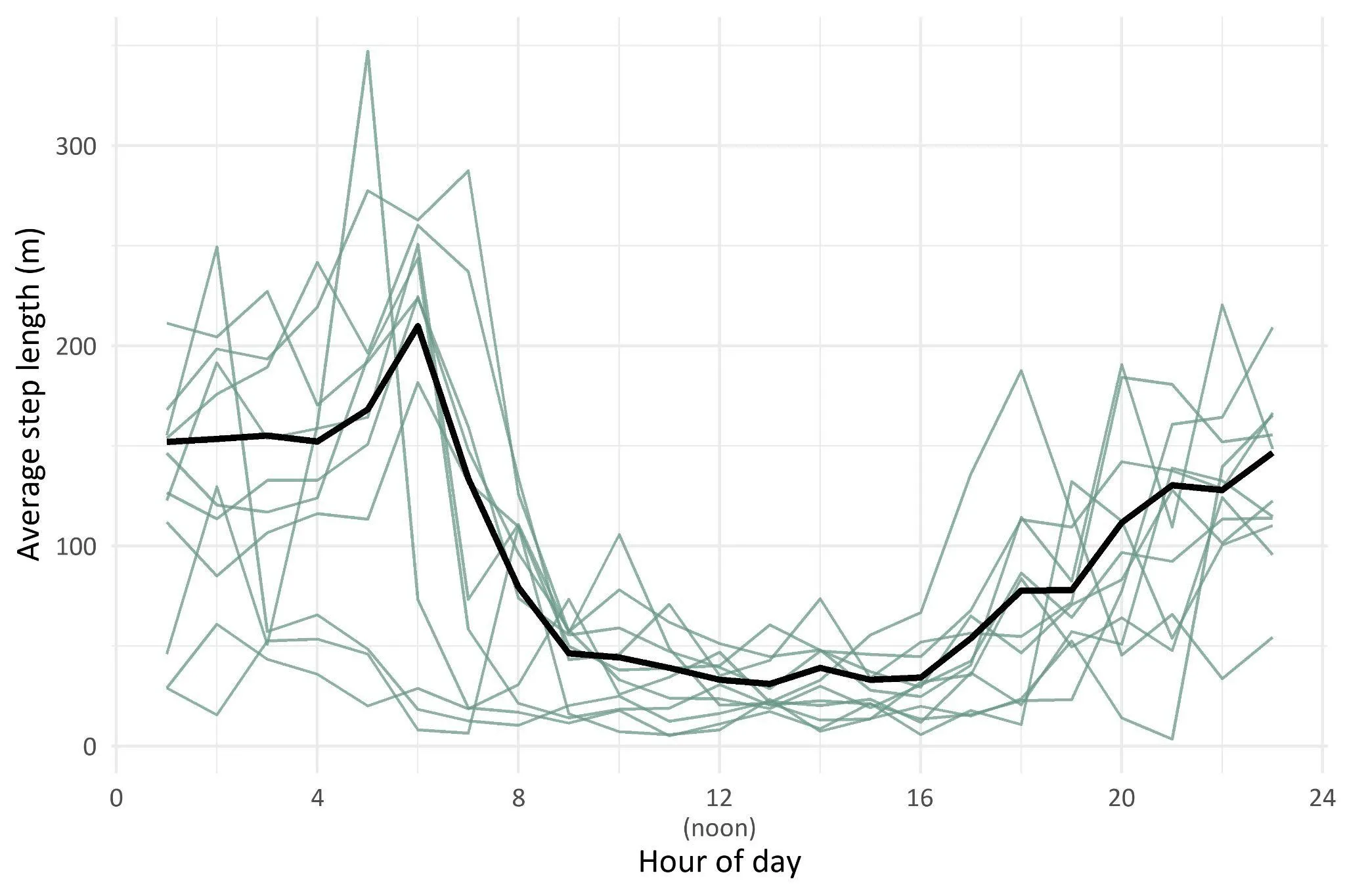
We found individual variation in wild pig movement (Table 1). Average step length per 1-hour fix interval was 83 m (SD = 132 m) across all individuals, with maximum step lengths ranging from 397 m to 1498 m. In general, pigs moved shorter distances during daytime hours, and had longer step lengths at night (Figure 2). On average, female pigs had lower mean net displacement across their trajectories (0.51 ± 0.52 km) than males (1.25 ± 0.64 km), as well as lower maximum net displacement (females = 2.16 km, males = 2.78 km). The largest displacements were 5.47 km (pig M23) and 4.09 km (pig F20).
Dataset limitations and opportunities
This dataset includes location data for GPS-tracked invasive wild pigs, with summary statistics on movement and space use. Data for some individuals was limited by relatively short deployments due to pig mortality or collar failure. Thick forest cover also resulted in variable transmission rates and periods when collars were unable to connect to the satellite.
Despite these limitations, there are opportunities for scientific value from this dataset. Publishing data associated with invasive species like wild pigs is valuable, since lethal removal may be prioritized over post-capture release for research, limiting opportunities to collect data. Population and density estimation models like mark-recapture rely on some spatial knowledge of the target species, so resource managers looking to understand populations could benefit from these data (Jiménez et al., 2016). Future work could also leverage this dataset to further investigate ecological questions about wild pigs, such as factors driving habitat and space use (Clontz et al., 2022; Evans et al., 2024). Furthermore, reporting data from specific sites could help characterize regional variation among individuals and populations, particularly important for Sus scrofa that has a global distribution and broad impacts (Risch et al., 2021, Wehr, 2021).
Acknowledgments
This project was supported by the Clemson University Creative Inquiries program. Thanks to the undergraduates who participated in the Creative Inquiry for your dedication to collaring and studying wild pigs. We also appreciate support from the Clemson University University Forest for the opportunity to carry out research on the property.
Author Contributions
Erin K. Buchholtz: Conceptualization, data curation, formal analysis, funding, methodology, visualization, writing – original draft
Andrew Jamison: Conceptualization, data curation, writing – review
Greg Yarrow: Conceptualization, data curation, funding, writing – review
Data Availability
The datasets for this study, including the metadata regarding each animal, are publicly archived in the Movebank Repository and (can be found here; Buchholtz et al. 2025).
Any use of trade, firm, or product names is for descriptive purposes only and does not imply endorsement by the U.S. Government.
Transparent Peer Review
Results from the Transparent Peer Review can be found here.
Recommended Citation
Buchholtz, E.K., A. Jamison, and G. Yarrow. 2025. Invasive wild pig movement and space use in a mixed-use forest landscape, South Carolina. Stacks Journal: 25014. https://doi.org/10.60102/stacks-25014
References
Adkins, R. N., and L. A. Harveson. 2007. Demographic and spatial characteristics of feral hogs in the Chihuahuan Desert, Texas. Human-Wildlife Conflicts 1: 152–160. http://www.jstor.org/stable/24875075.
Buchholtz, E. K., G. Yarrow, and A. Jamison. 2025. Data from: Invasive wild pig movement and space use in a mixed-use forest landscape, South Carolina. Movebank Data Repository. https://doi.org/10.5441/001/1.667.
Calabrese, J. M., C. H. Fleming, and E. Gurarie. 2016. ctmm: An R package for analyzing animal relocation data as a continuous-time stochastic process. Methods in Ecology and Evolution 7: 1124-1132. https://doi.org/10.1111/2041-210X.12559.
Calenge, C., S. Dray, and M. Royer. 2023. adehabitatLT: Analysis of Animal Movements, R package (v0.3.27). https://CRAN.R-project.org/package=adehabitatLT.
Clontz, L. M., K. M. Pepin, K. C. VerCauteren, and J. C. Beasley. 2022. Influence of biotic and abiotic factors on home range size and shape of invasive wild pigs (Sus scrofa). Pest Management Science 78: 914–928. https://doi.org/10.1002/ps.6701.
Dewitz, J. 2021. National Land Cover Database (NLCD) 2019 Products (v2.0). U.S. Geological Survey data release. https://doi.org/10.5066/P9KZCM54.
Evans, T. S., N. Ellison, M. R. Boudreau, B. K. Strickland, G. M. Street, and R. B. Iglay. 2024. What drives wild pig (Sus scrofa) movement in bottomland and upland forests? Movement Ecology 12: 32. https://doi.org/10.1186/s40462-024-00472-y.
Fleming, C. H., J. M. Calabrese, D. Xianghui, K. Winner, B. Reineking, G. Peron, M. J. Noonan, B. Kranstauber, C. Wilhite, E. Gurarie, K. Safi, P. C. Cross, T. Mueller, R. C. de Paula, T. S. Akre, J. Drescher‐Lehman, A. L. Harrison, and R. G. Morato, R. G. 2023. ctmm: Continuous-Time Movement Modeling R package (v1.2.0). https://doi.org/10.32614/CRAN.package.ctmm.
Froehly, J. L., N. R. Beane, D. E. Evans, K. E. Cagle, and D. S. Jachowski. 2020. Using multi-scale behavioral investigations to inform wild pig (Sus scrofa) population management. PloS one 15: e0228705. https://doi.org/10.1371/journal.pone.0228705.
Garabedian, J. E., K. J. Cox, M. Vukovich, and J. C. Kilgo. 2023. Co‐occurrence of native white‐tailed deer and invasive wild pigs: Evidence for competition? Ecosphere 14: e4435. https://doi.org/10.1002/ecs2.4435.
Jiménez, J., R. Higuero, J. F. Charre-Medellin, and P. Acevedo, P. 2016. Spatial mark-resight models to estimate feral pig population density. Hystrix 28: 208-213. http://doi.org/10.4404/hystrix-28.2-12141.
Kramer, C. J., M. R. Boudreau, R. Powers, K. C. VerCauteren, R. S. Miller, and R. K. Brook. 2024. Potential landscape connectivity for invasive wild pigs (Sus scrofa) across the northern prairies of North America. Biological Invasions 26: 2525-2538. https://doi.org/10.1007/s10530-024-03326-1.
McKee, S. C., J. J. Mayer, and S. A. Shwiff. 2024. Comprehensive Economic Impacts of Wild Pigs on Producers of Six Crops in the South-Eastern US and California. Agriculture 14: 153. https://doi.org/10.3390/agriculture14010153.
Miettinen, E., M. Melin, K. Holmala, A. Meller, V. M. Väänänen, O. Huitu, O., and M. Kunnasranta. 2023. Home ranges and movement patterns of wild boars (Sus scrofa) at the northern edge of the species’ distribution range. Mammal Research 68: 611-623. https://doi.org/10.1007/s13364-023-00710-5.
Miller, R. S., S. J. Sweeney, C. Slootmaker, D. A. Grear, P. A. Di Salvo, D. Kiser, and S. A. Shwiff. 2017. Cross-species transmission potential between wild pigs, livestock, poultry, wildlife, and humans: Implications for disease risk management in North America. Scientific Reports 7: 7821. https://doi.org/10.1038/s41598-017-07336-z.
R Core Team. 2023. R: A language and environment for statistical computing (v4.3.2) . R Foundation for Statistical Computing. https://www.R-project.org/.
Risch, D. R., J. Ringma, and M. R. Price. 2021. The global impact of wild pigs (Sus scrofa) on terrestrial biodiversity. Scientific Reports 11: 13256. https://doi.org/10.1038/s41598-021-92691-1.
Southeastern Cooperative Wildlife Disease Study. 1982. National feral swine map. University of Georgia. https://www.aphis.usda.gov/sites/default/files/styles/default/public/1982-national-swine-map-county.jpg.
Southeastern Cooperative Wildlife Disease Study. 2024. National feral swine map. University of Georgia. https://www.aphis.usda.gov/sites/default/files/styles/default/public/2025-02/2024-feral-swine-population-map.jpg.

Wehr, N. H. 2021. Historical range expansion and biological changes of Sus scrofa corresponding to domestication and feralization. Mammal Research 66: 1–12. https://doi.org/10.1007/s13364-020-00534-7.
Open Access
Peer-Reviewed
Creative Commons
Submitted: 12 June 2025
Accepted: 16 October 2025
Published: 11 December 2025
Clemson University Institute for Parks and the Clemson University Creative Inquiries program
Conflicts of Interest:
The authors declares no conflicts of interest.


