Identifying Communal Crow Roost Dynamics and Transitions through Citizen Science
CollaboratorsReviewers can opt-in to be listed as a Collaborator on the manuscript as recognition for their contributions.: Tyler Brasington, Daniel Ludwig, & Grace Kahler + 1 other reviewer
* This article is part of a Special Issue from Urban Wildlife Working Group.
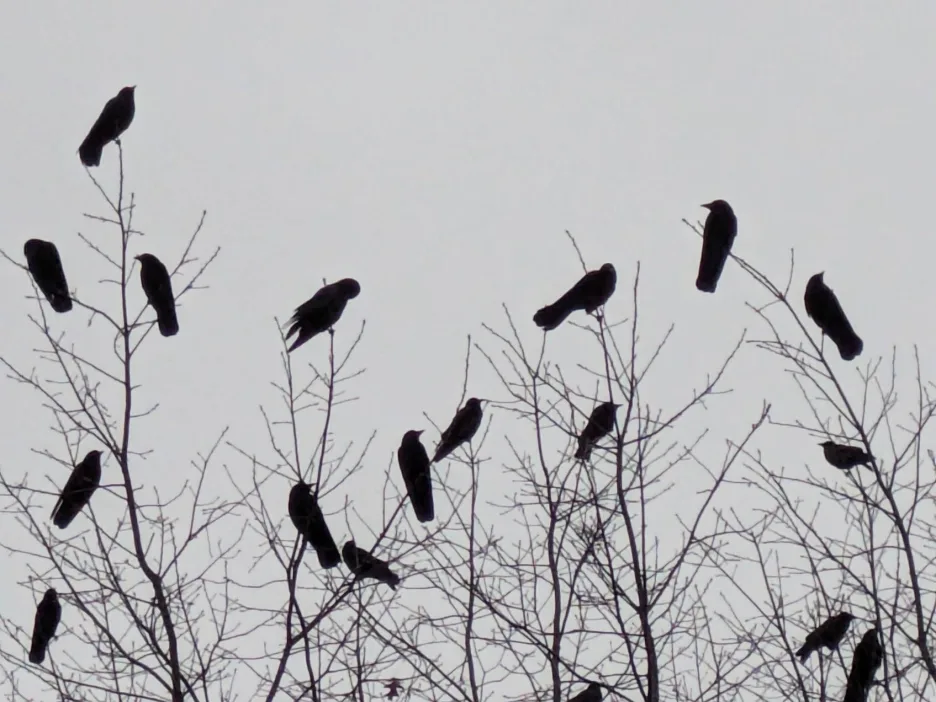
Abstract photo. A group of 18 American crows (Corvus brachyrhynchos) pre-roosting near a communal roost in Redmond, WA. Photograph by Douglas W. Wacker, 11-14-2024.
Abstract
American crows (Corvus brachyrhynchos) form large, nightly communal roosts of 100s to 100,000s of individuals throughout the non-breeding season. Obtaining comparable estimates of their numbers facilitates monitoring and understanding of roost dynamics. We describe a simple counting method that utilizes citizen scientists to produce annual estimates of crows using a large communal roost in Bothell, WA. Over the last ten years, volunteers have counted crows during their pre-roost approach at multiple flyover locations predictable in space and time. Observed changes in the number of crows led to the discovery of a spontaneous roost dissolution (i.e., not intentionally caused by humans), ephemeral roosting sites, and two newly formed, longer-term communal roosts. Similar citizen scientist-based approaches can be applied at other sites to better assess and understand the general dynamics of avian roosting behavior and build public awareness of and connection with urban wildlife.
Keywords: urban wildlife, American crow, roosting, citizen science, group behavior, non-breeding, Christmas Bird Count
Introduction
American crows (Corvus brachyrhynchos) are seasonally-breeding songbirds in the Family Corvidae, which also includes other crow species, ravens, jays, and magpies (Caffrey et al., 2025; Winkler et al., 2020). Similar to some other avian species, including multiple Corvid taxa, American Crows form communal roosts numbering in the 100s to 100,000s, primarily when not breeding (Allen, 1982; Caffrey et al., 2025; Rhoads, 1886). Crows move daily between their nightly roost and diurnal foraging areas (Stouffer & Caccamise, 1991). They follow similar routes when returning to their roost, forming temporally and spatially predictable groups (Kalmbach, 1916; Moore & Switzer, 1998). Crows remain in cacophonous pre-roost aggregations before moving en masse to their roost where they remain until morning (Abadi et al., 2019).
Estimating roosting crow numbers is challenging due to the number of individuals, circling flights over the roosting area, potential inaccessibility, and darkness. Kalmbach (1916) outlined two approaches for counting: sampling perching crows during roosting and counting flying birds as they arrive. Granger and Provorse (2025) made a Herculean effort to sample perching crows in an urban Portland, OR roost, but this was only possible because their site was accessible. All roosts identified in western Washington state are in wetlands or forested areas, difficult to traverse in darkness without disrupting the birds there.
Here, we describe a citizen scientist-based effort, aligned with the annual Audubon Christmas Bird Count (CBC), to estimate the number of crows using a communal roost in Bothell, WA (Figure 1A), by counting approaching individuals at multiple locations, consistent with previously described flightline observations of red-winged blackbirds (Agelaius phoeniceus) (Meanley, 1965). Citizen science initiatives have a long and successful history of acquiring important animal count and movement information (Barlow et al., 2015; Tulloch et al., 2013; Yun et al., 2024). Over a 4-year period, we identified unusual increases and decreases in our counts, allowing us to detect a spontaneous roost dissolution, ephemeral and potentially transitional roosting sites, and two emergent, longer-term communal roosts (Figure 1).
Roost descriptions
The former crow roost (Figure1A) in Bothell, WA (47.76096, -122.18621) was situated adjacent to residential and commercial areas between Washington State Highway 522 and Interstate 405, 100 m from the nearest paved road and 210 m from the nearest building (King County iMap 2025). Crows roosted above a floodplain within the larger North Creek Wetlands Restoration surrounding North Creek on the University of Washington Bothell campus in a mixed wooded wetlands, which is dominated by red alder (Alnus Rubra) mixed with other tree species, including black cottonwood (Populus trichocarpa) and Pacific red cedar (Thuja plicata) (Lee, 2002, King County iMap 2025). The current crow roost (Figure 1B) in Redmond, WA (47.70682, -122.15139) is situated adjacent to agricultural and commercial areas between Willows Rd NE and NE 116th St., 120 m from the nearest paved road and 190 m from the nearest building (King County iMap 2025). Crows roost above a floodplain within the larger undeveloped Sammamish Valley Park, primarily within a 11,000 m2 copse of trees dominated by Sitka willow (Salix sitchensis) and Scouler’s willow (Salix scouleriana) mixed with other tree species, including poplars (Populus spp.) (Brumbaugh & Associates, 2015, King County iMap 2025). The copse is bordered by invasive Himalayan blackberry (Rubus armeniacus) and native thimbleberry (Rubus parviflorus). The current crow roost (Figure 1C) in north Bothell, WA (47.807556, -122.210194) is situated within an undeveloped wetlands surrounding North Creek adjacent to a commercial area along Washington State Highway 527, 160 m from the nearest paved road and 90 m from the nearest building (King County iMap 2025). Crows roost in patches of willow (Salix spp.) within a larger area dominated by reed canary grass (Phalaris arundinacea) and spotted jewelweed (Impatiens capensis); the entire area is bordered by Himalayan blackberry (Rubus armeniacus) and poplars (Populus spp.), which some crows use for pre-roosting.
Methods and Materials
American crow counts across a 30-year Christmas Bird Count (CBC) dataset from the Pilchuck Audubon Society varied widely, even when corrected for effort (Figure 2 & S1). The more extreme year-to-year vacillations were thought to reflect methodological issues. Crows form large, moving aggregations as they fly towards their communal roosts (Kalmbach, 1916; Moore & Switzer, 1998), and in some years volunteers might have counted such groups, while in others they did not. We created a protocol to standardize counts across years, which included limiting counts to crows flying within the CBC circle during their afternoon approach to a communal roost in Bothell, WA (Figure 1A and 3).
In order to locate potential crow counting locations, volunteers scanned multiple areas in each of the cardinal directions around the Bothell roost. Crow counts and directions of travel from these observations were used to identify four predictable, pre-roost flyover locations along four waterways (Figure 3). Based on the trajectory of flight across these locations and follow up visual observations along the flight routes, we determined that groups of crows flying over these four sites did not intersect with one another. From 2016 to 2025, during Pilchuck Audubon Society’s Edmonds CBC, two to three volunteers were stationed at each location and independently conducted per-minute counts of crows flying over from 90 minutes prior until 30 minutes after sunset. When numbers swelled, volunteers block counted groups of birds (Bibby, 2000). Total counts per site were averaged across observers.
Results
Between 2016 and 2021, an annual average of 13,110 +/- 1,860 crows were counted flying towards the Bothell roost (Table 1). During this time, large pre-roosting aggregations were consistently observed near this roost. In 2022, total counts swelled to 20,774, and pre-roosting behavior did not appear unusual. Based on this increase, we resurveyed crow approach behavior. In November 2023, we observed a newly-established roost in Redmond, WA (Figure 1B and 3). This site was visited in 2019, and no roosting behavior was observed at that time.
|
Location |
2016 |
2017 |
2018 |
2019 |
2020* |
2021 |
2022 |
2023 |
2024 |
2025 |
|---|---|---|---|---|---|---|---|---|---|---|
|
Swamp Creek (SC), Lynnwood, WA |
1151 |
1256 |
321 |
1106 |
|
127 |
525 |
** |
|
|
|
Lake Washington (LW), Kenmore, WA |
5246 |
6414 |
6012 |
3788 |
|
4573 |
5386 |
2302 |
2127 |
1289 |
|
Little Bear Creek (LBC), Woodinville, WA |
3176 |
1447 |
2364 |
2071 |
|
3276 |
4782 |
2617 |
225 |
266 |
|
North Creek (NC), Mill Creek, WA |
4712 |
4996 |
6103 |
4959 |
|
2453 |
10081 |
4050 |
1691 |
2079 |
|
TOTALS |
14285 |
14113 |
14800 |
11924 |
|
10429 |
20774 |
8969 |
4043 |
3634 |
|
Sammamish River (SR), Woodinville, WA |
|
|
|
|
|
|
|
9823 |
8603 |
7397 |
|
TOTALS (including crows moving towards Redmond roost) |
|
|
|
|
|
|
|
18792 |
12646 |
11031 |
|
* Counts cancelled in 2020 due to the Covid-19 pandemic |
||||||||||
|
** Swamp Creek no longer used as a site, because of consistently low counts and prioritizing counts at Sammamish River, Woodinville, WA |
||||||||||
To account for crows moving towards this new roost, we established a new counting location along the Sammamish River (SR) in 2023, 3.4 km SSE of the Bothell roost (Figure 3). 2023 counts at MC, LW, and LBC decreased to 8,969, while counts at SR were 9,823. In 2024 and 2025, counts at MC, LW, and LBC continued to decline to 4,043 and 3,634, respectively. These reductions were concomitant with our observations of fewer crows using the Bothell, WA, roost. Since January 2025, the Bothell roost has been abandoned.
Numbers at SR, representing birds moving towards the Redmond roost, decreased in 2024 and 2025 to 8,603 and 7,397, respectively. Due to these changes, approach behavior was resurveyed. In December 2024, a roost of thousands of crows was discovered in Mountlake Terrace, WA (47.782571, -122.329949). It is unclear how long crows had used this site; it had not previously been recognized as a roost and by January 2025, it was abandoned. In December 2025, we observed a roost of approximately 200 birds in north Bothell, WA (47.807198, -122.207419). By January 2026, this site was abandoned. However, in March 2026, observations of nearby pre-roosting behavior led us to discover another, larger roost in north Bothell (47.807556, -122.210194) very close to this ephemeral roosting site (Figure 3). It is unclear when this roost was established, but it was not previously detected and consists of thousands of individuals, suggesting it is also new. This roost is 5.5 km NNE of the former, now abandoned Bothell, WA roost and is also adjacent to North Creek.
Discussion
Over ten years, we used a citizen scientist-based approach to count crows moving towards a communal roost in Bothell, WA. This roost was gradually abandoned without intentional human harassment, and two new roosts were established along waterways connected to the previous roost. Roost shifting is much more likely to be reported in the scientific literature if induced by human harassment (Avery et al., 2008; Gorenzel et al., 2000). The reasons for spontaneous roost shifts remain unknown at this time and warrant further study. Because these shifts are unpredictable, it is important to monitor roosts to document changes as they occur. While our count estimates are likely conservative, they are comparable because they are made using a consistent protocol. The exact precision and accuracy of such counts could be assessed when roosts are accessible and ground-truthing is possible (Granger & Provorse, 2025).
Consistent monitoring using our approach can help address multiple open questions about crow roosting behavior. Roost numbers are greatest during winter, but roosts are also used during autumn and late summer, and sometimes even during the breeding season by non-breeding individuals (Caffrey et al., 2025). Semi-annual roost counts, as outlined here, could assess seasonal and geographical variation in roosting behavior and allow timely assessment of roost dissolution or new roost establishment if numbers change. As crows abandoned the Bothell roost, multiple smaller roosts appeared and disappeared. Better monitoring of roost dynamics could help determine whether such ephemeral roosts only form during roost dissolution or are more common than currently understood.
Crow roosts impact their local environment, and better understanding their dynamics can help inform management and, if warranted, dispersal decisions (Gorenzel et al., 2000). Waste from crow roosts can lead to both aesthetic and potential human health issues, especially in urban areas (Gorenzel & Salmon, 1992; Sen et al., 2019). Crows can also alter the behavior of other urban wildlife using the areas under their roosts (Wacker et al., 2026). In some cases, crows have been harassed away from roosting areas (Gorenzel et al., 2000), but without basic background information on roost shifting, it is hard to predict whether they will move to equally problematic areas. While crows are sometimes viewed negatively for these reasons, many in the public are captivated by their intelligence and view them favorably (Jürgens et al., 2022), so it has been quite easy to find volunteers for our citizen scientist efforts.
Citizen scientists have successfully garnered important scientific data by monitoring the movements and populations of animals, including Corvids (Barlow et al., 2015; Tulloch et al., 2013; Yun et al., 2024). Tulloch et al. (2013) outlined eight important objectives for such initiatives, including enhancing public awareness and education, enlightening management decisions, refining protocols, and revealing/describing surprising or unforeseen findings, all of which are pertinent to this study. This project has already given the authors opportunity to offer multiple public talks about crow behavior in the communities near the communal roosts. In the future, we hope to expand our roost monitoring efforts to other areas of North America. By engaging interested citizens in roost monitoring, we can uncover important information about the dynamics of American crow roosting and build public connections with urban wildlife.


Acknowledgments
The authors would like to acknowledge Jason Adams for assistance with editing our manuscript, the City of Redmond and Kristen Lundquist at Brumbaugh & Associates for locating and providing the planting records for the Redmond roost site, Dan Barrett for help with field research, Janet Fisher for the tip about a potential ephemeral roost, and the following Audubon and student volunteers who contributed to this research: Dan Lombardo, Lexi Menth, Arianna Greer, Nancy York-Irwin, Sherri Nielson, Todd Gladfelter, Delphinia Wacker, Kris Tsujikawa, Lynae Slinden, Vanessa Lim, Steve Abel, Janice Ohrenschall, Mark Ohrenschall, Brooke Van Eyk, Steve Schroeder, Cheryl Beighle, Laura Ng, Dorothy Jacobsen, and many others.
Author Contributions
Douglas W. Wacker: conceptualization, data curation, formal analysis, investigation, methodology, project administration, supervision, validation, visualization, writing - original draft, writing - review & editing
Brian M. Zinke: data curation, formal analysis, methodology, project administration, validation, visualization, writing - original draft, writing - review & editing
Christopher D. Anderson: investigation, project administration, supervision, writing - review & editing
Alyssa S. Branca: investigation, methodology, project administration, supervision, writing - review & editing.
Data Availability
Study data are available by request from the National Audubon Society Audubon and Christmas Bird Count Websites (www.audubon.org, www.christmasbirdcount.org).
Transparent Peer Review
Results from the Transparent Peer Review can be found here.
Recommended Citation
Wacker, D. W., Zinke, B. M., Anderson, C. D., & Branca, A. S. (2026). Identifying Communal Crow Roost Dynamics and Transitions through Citizen Science. Stacks Journal: 26018. https://doi.org/10.60102/stacks-26018
Conflicts of Interest
The authors declare no conflicts of interest.
Funding Information
This research was funded by start-up funds provided by the University of Washington Bothell to Douglas W. Wacker.
AI Use Statement
Copyright
© 2026 Douglas W. Wacker, Brian M. Zinke, Christopher D. Anderson, & Alyssa S. Branca. This article is open access and distributed under the terms and conditions of the Creative Commons Attribution (CC BY 4.0) license.
Supplementary Information
References
Abadi, S. H., Wacker, D. W., Newton, J. G., & Flett, D. (2019). Acoustic localization of crows in pre-roost aggregations. The Journal of the Acoustical Society of America, 146(6), 4664–4671. https://doi.org/10.1121/1.5138133
Allen, H. L., Washington . Department of Game., & Young, L. S. (1982). An annotated bibliography of avian communal roosting. Washington Dept. of Game.
Avery, M. L., Tillman, E. A., & Humphrey, J. S. (2008). Effigies for dispersing urban crow roosts. Proceedings of the Vertebrate Pest Conference, 23. https://doi.org/10.5070/v423110599
Barlow, K., Briggs, P., Haysom, K., Hutson, A., Lechiara, N., Racey, P., Walsh, A., & Langton, S. (2015). Citizen science reveals trends in bat populations: The National Bat Monitoring Programme in Great Britain. Biological Conservation, 182, 14–26. https://doi.org/10.1016/j.biocon.2014.11.022
Bibby, C. J. (2000). Bird census techniques (2nd ed.). Academic Press.
Brumbaugh & Associates. (2015). Sammamish Valley Park Tree Mitigation Plan. Prepared for: City of Redmond, WA.
Caffrey, C., Verbeek, N. A., Clark, A. B., McGowan, K. J., & Pyle, P. (2025). American Crow (Corvus brachyrhynchos) (Version 1.5). In A. F. Poole, F. B. Gill, & M. G. Smith (Eds.), Birds of the World. Cornell Lab of Ornithology. https://doi.org/10.2173/bow.amecro.01.5
Gorenzel, W. P., & Salmon, T. P. (1992). Urban crow roosts in California. Proceedings of the Vertebrate Pest Conference, 15(15), 97–102.
Gorenzel, W. P., Salmon, T. P., Simmons, G. D., Barkhouse, B., & Quisenberry, M. P. (2000). Urban crow roosts-a nationwide phenomenon? Wildlife Damage Management Conferences – Proceedings, 25, 158–170.
Granger, G., & Provorse, R. (2025). Counting crows: deciphering the mysteries of Portland’s urban crow roost. Oregon Birds, 49(2), 84–93.
Jürgens, U. M., Hackett, P. M. W., Hunziker, M., & Patt, A. (2022). Wolves, crows, spiders, and people: A qualitative study yielding a three-layer framework for understanding Human–Wildlife relations. Diversity, 14(8), 591. https://doi.org/10.3390/d14080591
Kalmbach, E. R. (1916). Winter crow roosts. Yearbook of the United States Department of Agriculture, 1915, 83–100.
King County iMap [Interactive map]. (n.d.). King County, Washington. Retrieved August 28, 2026, from https://gismaps.kingcounty.gov/imap/
Lee, L.C. & Associates, Inc. (2002). Baseline monitoring report for the University of Washington Bothell, Cascadia Community College Campus North Creek and floodplain ecosystem restoration project. Prepared for: Washington State Department of General Administration. https://digitalcollections.lib.washington.edu/digital/collection/uwb2/id/2831/rec/35
Meanley, B. (1965). The roosting behavior of the red-winged black-bird in the southern United States. The Wilson Bulletin, 77(3), 217–228.
Moore, J. E., & Switzer, P. V. (1998). Preroosting aggregations in the American crow, Corvus brachyrhyncos. Canadian Journal of Zoology, 76(3), 508–512. https://doi.org/10.1139/z97-229
National Audubon Society. 2025. “Christmas Bird Count Results”. Available http://www.christmasbirdcount.org .
Rhoads, S. W. (1886). Crow roosts and roosting crows. The American Naturalist, 20(8), 691–701. https://doi.org/10.1086/274308
Sen, K., Berglund, T., Soares, M. A., Taheri, B., Ma, Y., Khalil, L., Fridge, M., Lu, J., & Turner, R. J. (2019). Antibiotic resistance of E. coli isolated from a constructed wetland dominated by a crow roost, with emphasis on ESBL and AmpC containing E. coli. Frontiers in Microbiology, 10. https://doi.org/10.3389/fmicb.2019.01034
Stouffer, P. C., & Caccamise, D. F. (1991). Roosting and diurnal movements of radio-tagged American crows. The Wilson Bulletin, 103(3), 387–400.
Tulloch, A. I., Possingham, H. P., Joseph, L. N., Szabo, J., & Martin, T. G. (2013). Realising the full potential of citizen science monitoring programs. Biological Conservation, 165, 128–138. https://doi.org/10.1016/j.biocon.2013.05.025
Wacker, D. W., Wotus, C., King, T. R., Geller, B. L., Greer, A. J., & Hartley, R. S. (2026). Effects of Communal Crow Roosts on Seasonal Territorial Aggression and Vigilance in Song Sparrows. Northwestern Naturalist, 107(2), 98–108. https://doi.org/10.1898/nwn25-20
Winkler, D. W., Billerman, S. M., & Lovette, I. J. (2020). Crows, Jays, and Magpies (Corvidae) (Version 1.0). In A. F. Poole, F. B. Gill, & M. G. Smith (Eds.), Birds of the World. Cornell Lab of Ornithology. https://doi.org/10.2173/bow.corvid1.01
Yun, J., Shin, W., Kim, J., Thorne, J. H., & Song, Y. (2024). Citizen-science data identifies the daily movement patterns and habitat associations of a nocturnal urban-invading bird species (Corvus frugilegus). Urban Ecosystems, 27(5), 1407–1416. https://doi.org/10.1007/s11252-024-01508-2