Potential Pronghorn (Antilocapra americana) Susceptibility to Chronic Wasting Disease Through PRNP Sequencing
CollaboratorsReviewers can opt-in to be listed as a Collaborator on the manuscript as recognition for their contributions.: 2 reviewers
* This article is part of a Special Issue from the Wildlife Health Working Group.
Abstract
For years, Chronic Wasting Disease (CWD) has posed significant concerns for wildlife managers, public health officials, and hunters. Given the complexity of prion transmission and emergence of novel prion diseases, interfamilial transmission represents a potential challenge to CWD management. Pronghorn (Antilocapra americana) use similar habitats and are geographically sympatric with some CWD-susceptible cervids. However, little research has specifically focused upon pronghorn susceptibility to prion diseases, namely CWD, as their membership in a non-cervid ungulate family provides the conceptual framework to assume resistance. Yet, pronghorn are sympatric with free-ranging white-tailed deer (Odocoileus virginianus), elk (Cervus canadensis), and mule deer (O. hemionus) throughout their geographic range. We sequenced PRNP exon 3 in pronghorn from Texas (n = 47) and New Mexico (n = 28) to compare amino acid sequences of known susceptible cervids and assess if pronghorn could be susceptible to prion diseases. Pronghorn possess one additional octapeptide repeat relative to the five repeats observed in cervids, and while whole-gene phylogenetic analyses place pronghorn outside Cervidae. Pronghorn share amino acids with cervids at loci 95, 96, 116, 132, 225 and 226 – the positions most strongly associated with CWD susceptibility. At locus 173, pronghorn share the bovid residue (serine) rather than the cervid residue (asparagine), further illustrating that pronghorn occupy a genuinely intermediate molecular position between these lineages. Although no CWD-positive pronghorn detections have been reported in the literature, the assumption of resistance based on taxonomic placement is not supported by site-specific sequence data, and this study provides a molecular basis for reassessing that assumption.
Keywords: Antilocapra americana , chronic wasting disease, prion protein, PRNP, pronghorn
Introduction
Over the last century, pronghorn (Antilocapra americana) have experienced dramatic reductions in range and population size (French, 2015; McCabe et al., 2004; Seton, 1909; White et al., 2012) largely attributed to habitat loss, fencing, livestock grazing, and overhunting (O’Gara & Yoakum, 2004; Simpson et al., 2007). Beyond these factors, pronghorn are susceptible to disease outbreaks and die-offs due to their grouping and social cohesion, and disease can have major negative effects on population stability and recruitment (Jones et al., 2023; Thorne et al., 1988; Weaver, 2013; White et al., 2012). Pronghorn have experienced localized extirpations due to epizootic hemorrhagic disease (EHD), blue-tongue virus (BTV), haemonchosis, and parainfluenza virus type 3 (PI3) in some years (Dubay et al., 2006; Jones et al., 2023; Weaver, 2013). Similarly, each of these diseases can impact free-ranging white-tailed deer (Odocoileus virginianus) and mule deer (O. hemionus) and trigger significant mortality events in some years (Baygents & Bani-Yaghoub, 2018; Cain et al., 2018; Conner & Miller, 2004). Pronghorn are commonly sympatric with white-tailed deer, elk (Cervus canadensis), and mule deer, yet there is limited published research on either verified or assumed pathogen transmission among sympatric cervids and pronghorn (see Cullingham et al., 2020).
Little is known about pronghorn in relation to prion diseases, particularly Chronic Wasting Disease (CWD), and there are few references that have posited that wild ungulates other than Cervids may be susceptible to prion disease, aside from Cullingham et al. (2020). To date, no studies have investigated pronghorn susceptibility to or pathology of prion diseases, including CWD. Cullingham et al. (2020) used the cytb (cytochrome B) gene to assemble a phylogeny of mammalian taxa, including cattle (Bos taurus, susceptible to Bovine Spongiform Encephalopathy, ergo BSE) hypothesized to be (a) susceptible, (b) resistant, or (c) unknown and compared PrPCamino acid polymorphisms from sequencing wild ungulates (n = 578) for PRNP to identify susceptibility probability. Using this cytb phylogeny, they found that CWD susceptibility is highly correlated with phylogenetic history. By including species like pronghorn who have unknown susceptibility to CWD, Cullingham et al. (2020) suggested that pronghorn potentially have a “lowered” species barrier to prion disease. If pronghorn are indeed susceptible, then potential transmission among known-susceptible, sympatric species and pronghorn represents a potential risk throughout their range, as pronghorn occur near the primary CWD endemic region in the United States (O’Gara & Yoakum, 2004; USGS, 2025, Figure 1). The increasing regional prevalence of CWD in these sympatric cervids with pronghorn underscores a need for further research to understand pronghorn susceptibility to prion diseases, namely CWD.
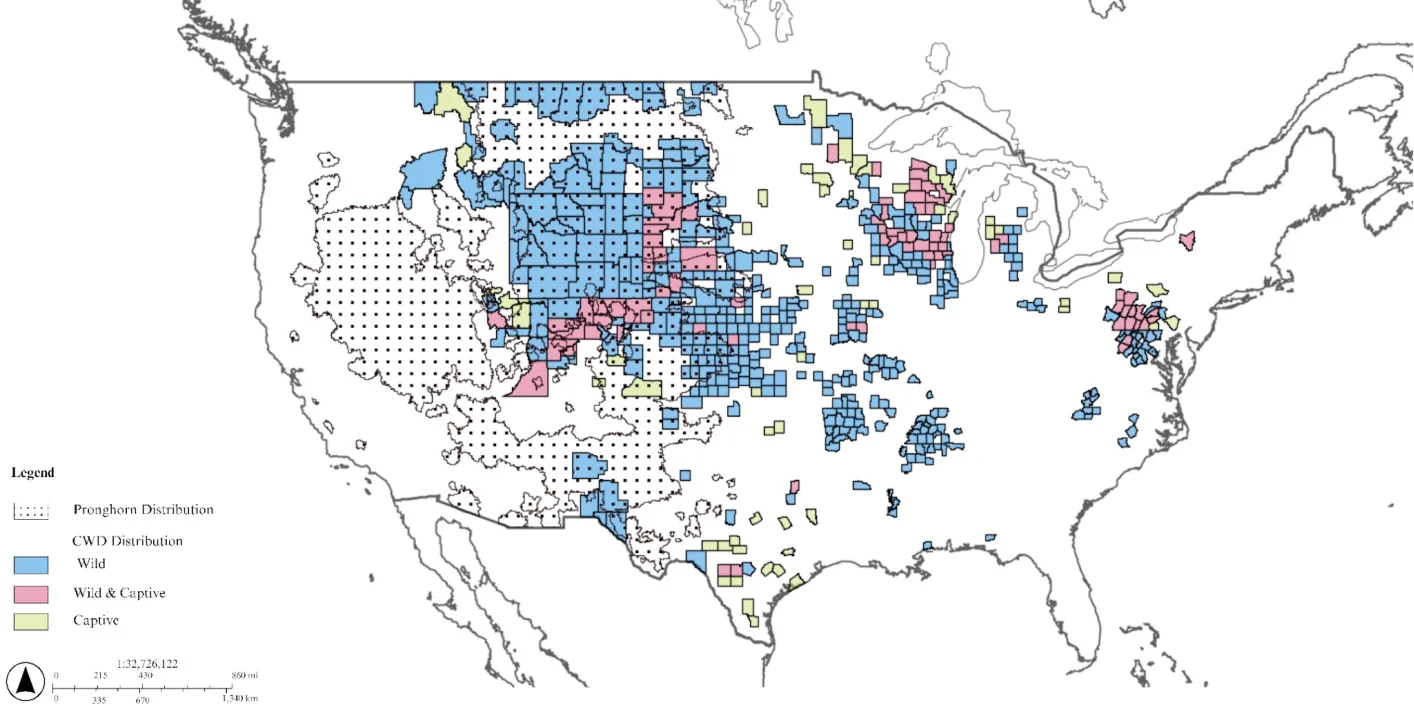
Figure 1. Overlap among the known national Chronic Wasting Disease (CWD) endemic areas, including detections in wild and captive Cervids (red, green and blue polygons, Richards 2021) and pronghorn distribution (dotted polygons, USGS 2018).
This study had three primary objectives: (a) PRNP characterization in pronghorn, (b) phylogenetic analyses to understand evolutionary relationships, and (c) comparative analyses with native, known CWD-susceptible cervids. We sequenced PRNP in pronghorn from Texas and New Mexico to determine the specific amino acid sequence of prion protein (PrPC) to identify any genetic variations within pronghorn PRNP. By comparing the PRNP amino acid sequences of pronghorn to those of native, sympatric cervids like white-tailed deer, mule deer, and elk, we aimed to assess genetic similarity at loci associated with susceptibility to prion diseases.
Methods and Materials
Sample acquisition
Free-ranging pronghorn samples (n = 73) consisted of 0.1 g of ear tissue clips (n = 45) from Texas pronghorn and whole blood samples (n = 28) from New Mexico pronghorn. The Texas samples consisted of adult males (n = 8), adult females (n = 37), and two additional adults (of unknown sex) during 2019 capture and translocation efforts in Irion, Culberson, and Hudspeth counties by Texas Parks and Wildlife Department (TPWD; acquired from Shawn Gray, Pronghorn and Mule Deer Program Leader, TPWD). These samples were stored in liquid nitrogen at the Natural Science Research Laboratory (NSRL) at Texas Tech University (Loan #OL2021-080; Patrick 2023). The New Mexico samples were whole blood, stored in anticoagulant-treated (ethylenediaminetetraacetic acid; EDTA) tubes collected from male (n = 7) and female (n = 21) juvenile and adult pronghorn from a 2015 capture and translocation effort in Colfax County, New Mexico (acquired from Tony Opatz, Pronghorn Biologist, New Mexico Department of Game and Fish); see Patrick (2023). Pronghorn in the study areas were not screened for prion infection. All samples were collected during capture events by TPWD and NMDGF staff following approved guidelines and were reviewed by the Texas Tech University Institutional Animal Care and Use Committee (IACUC Protocol Numbers 13011-01, 17037-04C, and 2024-1602).
DNA amplification and sequencing
Amplification, extraction, and sequencing methods followed those established by Buchholz et al. (2021), with some deviations detailed below; more methodological details can be found in Patrick (2023). We isolated genomic DNA (gDNA) using the Qiagen DNeasy kit (Qiagen Inc., Valencia, CA, USA) from 0.1 g ear tissue samples and from 100 µL anticoagulant-treated blood. The full length of PRNP exon 3 (771 bp in cervids, 854 bp in pronghorn) and up to 53 base pairs (bp) of the 5’ flanking sequence and 83 bp of the 3’ flanking sequence was amplified with polymerase chain reaction methods (PCR, Saiki et al., 1988), using the amplification primers MD582F and MD1479RC, established by Jewell et al. (2006). PCR reactions for the ear tissue samples followed the standard HotStarTaq (Qiagen Inc., Valencia, CA, USA) protocol. The thermal profile followed that of Buchholz et al. (2021) with annealing temperature modified to 54°C for 45s (Patrick, 2023). Due to poor amplification with HotStarTaq likely due to sample type and age, reactions for the New Mexico blood samples followed the standard CYTIVA BeadKit (Global Life Sciences Solutions USA, Marlborough, MA, USA) protocol, details of which can be found in Patrick (2023). No differences attributable to extraction or amplification methods were observed in the resulting sequences.
All PCR products were purified with ExoSAP-IT PCR Product Cleanup and cycle-sequenced using BigDyeTerminator v3.1 (Applied Biosystems, Foster City, CA, USA) with the primers from Jewell et al. (2006; MD582F, MD1479RC, 12, and 3FL1) used to amplify fragments on both the forward and reverse strands (Patrick, 2023). Sequencing products were then purified with Sephadex columns (Princeton Separation, Adelphia, NJ, USA) and centrifugation, followed by dehydration and resuspension in formamide prior to shipping to Eurofins Genomics where sequences were analyzed on an ABI Prism 3730xl automated sequencer (Biotechnology Resource Center, Institute of Biotechnology, Cornell University, Ithaca, New York; Eurofins Genomics, Louisville, Kentucky). Raw sequence reads returned were visually inspected, and chromatograms were inspected using Sequencher 4.10.1 software to verify all base changes (Gene Codes Corporation, Ann Arbor, Michigan).
Sequence analysis of PRNP exon 3
Nucleotide sequences were aligned and trimmed to the open reading frame (ORF) of PRNP exon 3 using MEGA-X 11.0.13 following Kumar et al. (2018). The trimmed nucleotide sequences were then translated into protein using the standard genetic code and inspected for any non-synonymous substitutions at the nucleotide and amino acid level. Additional nucleotide sequences of PRNP exon 3 representing taxa from all species of Ruminantia (n = 589), as well as one sequence from Przewalski’s horse (Equus przewalksii), were obtained from GenBank and served as comparative sequences to ensure all substitutions, if any, were observed in pronghorn (Table 1). The sequence from Przewalski’s horse was used as the outgroup for the phylogenetic analyses as a basal extant member of Perissodactyla (Der Sarkissian et al., 2015). Pronghorn PRNP exon 3 sequences were aligned against PRNP exon 3 sequences from white-tailed deer (GenBank: AY286008); mule deer (GenBank: MT709572); elk (GenBank: U21210); reindeer (Rangifer tarandus, GenBank: MN052820); the wild type domestic sheep (Ovis aries, PRNP-B allele, GenBank: DQ885787); cattle (Bos taurus, GenBank: DQ112003.1); and zebu (Bos indicus, GenBank: AY720680.1). Sequences were aligned to mule deer PNRP for comparison according to the locus referencing system in Robinson et al. (2012).
|
Order Family Subfamily Genus species |
Common Name |
Number of Individuals |
|
|---|---|---|---|
|
Perissodactyla |
|
|
|
|
Equidae |
|
|
|
|
Equus przewalskii |
Przewalki’s Horse |
1 |
|
|
|
|
|
|
|
Artiodactyla |
|
|
|
|
Giraffidae |
|
|
|
|
Giraffa camelopardalis |
Giraffe |
1 |
|
|
|
|
|
|
|
Antilocapridae |
|
|
|
|
Antilocapra americana |
Pronghorn |
79 |
|
|
|
|
|
|
|
Moschidae |
|
|
|
|
Moschus chrysogaster |
Musk Deer |
1 |
|
|
|
|
|
|
|
Cervidae |
|
|
|
|
|
|
|
|
|
Cervinae |
|
|
|
|
Axis axis |
Axis Deer |
2 |
|
|
Muntiacus reevesi |
Reeve’s Muntjac |
4 |
|
|
Dama dama |
Fallow Deer |
1 |
|
|
Elaphurus davidianus |
Pere David’s Deer |
1 |
|
|
Cervus canadensis |
Elk |
8 |
|
|
Cervus elaphus |
Red Deer |
12 |
|
|
Cervus nippon |
Sika Deer |
3 |
|
|
|
|
|
|
|
Capreolinae |
|
|
|
|
Alces alces |
Moose |
5 |
|
|
Capreolus capreolus |
Roe Deer |
2 |
|
|
Hydropotes inermis |
Water Deer |
6 |
|
|
Rangifer tarandus |
Reindeer |
12 |
|
|
Odocoileus virginianus |
White-tailed Deer |
60 |
|
|
Odocoileus hemionus |
Mule Deer |
21 |
|
|
|
|
|
|
|
Bovidae |
|
|
|
|
Kobus ellipsiprymnus |
Waterbuck |
2 |
|
|
Kobus megaceros |
Nile Lechwe |
1 |
|
|
|
|
|
|
|
Antilopinae |
|
|
|
|
Antilope cervicapra |
Blackbuck |
1 |
|
|
Eudorcas thomsonii |
Thomson’s Gazelle |
1 |
|
|
Gazella subgutturosa |
Goitered Gazelle |
1 |
|
|
Procapra gutturosa |
Zeren |
11 |
|
|
|
|
|
|
|
Bovinae |
|
|
|
|
Connochaetes taurinus |
Blue Wildebeest |
1 |
|
|
Boselaphus tragocamelus |
Nilgai |
2 |
|
|
Bison bison |
American Bison |
2 |
|
|
Bison bonasus |
European Bison |
3 |
|
|
Syncerus caffer |
African Buffalo |
4 |
|
|
Bos primigenius |
Eurasian Aurochs |
2 |
|
|
Bos javanicus |
Banteng |
4 |
|
|
Bos gaurus |
Gaur |
1 |
|
|
Bos grunniens |
Domestic Yak |
12 |
|
|
Bos taurus |
Domestic Cattle |
81 |
|
|
Bubalis depressicornis |
Lowland Anoa |
2 |
|
|
Bubalis bubalis |
Domestic Water Buffalo |
16 |
|
|
Tragelaphus angasii |
Lowland Nyala |
3 |
|
|
Tragelaphus spekeii |
Sitatunga |
1 |
|
|
Tragelaphus imberbis |
Lesser Kudu |
1 |
|
|
Tragelaphus strepticeros |
Greater Kudu |
4 |
|
|
Taurotragus oryx |
Common Eland |
|
|
|
|
|
|
|
|
Hippotraginae |
|
|
|
|
Hippotragus niger |
Sable Antelope |
3 |
|
|
Addax nasomasculatus |
Addax |
1 |
|
|
|
|
|
|
|
Caprinae |
|
|
|
|
Ovis canadensis |
Bighorn Sheep |
6 |
|
|
Ovis dalli |
Dall Sheep |
2 |
|
|
Ovis orientalis |
Mouflon |
1 |
|
|
Ovis aries |
Domestic Sheep |
67 |
|
|
Ammotragus lervia |
Aoudad |
1 |
|
|
Arabitragus jayakari |
Arabian Tahr |
1 |
|
|
Budorcas taxicolor |
Takin |
2 |
|
|
Capra falconeri |
Markhor |
1 |
|
|
Capra ibex |
Alpine Ibex |
1 |
|
|
Capra nubiana |
Nubian Ibex |
1 |
|
|
Capra hircus |
Goat |
121 |
|
|
Oreamnos americanus |
Mountain Goat |
1 |
|
|
Rupicapra rupicapra |
Chamois |
3 |
|
|
Rupicapra pyrenaica |
Pyrenean Chamois |
2 |
|
Phylogenetic analyses
To identify the phylogenetic placement of pronghorn for PRNP, an initial dataset of the 589 individual sequences from Ruminantia were obtained from GenBank in addition to the 73 sequences of Texas and New Mexico pronghorn used in this study (see Table 1). A set of 88 maximum likelihood models were used to evaluate DNA sequences using jModelTest-2.1.7 with the Akaike Information Criterion with a correction for small sample sizes (AICc) and identified the General Time Reversible plus Inverse Gamma (GTR+I+G) model of evolution (-lnL = 2,326.0861) as the most appropriate for the dataset. These models were then verified utilizing the ModelFinder tool in W-IQ-TREE (Kalyaanamoorthy et al., 2017; Trifinopoulos et al., 2016). A maximum likelihood analysis using a Bayesian inference model was conducted in BEAST2 and BEAUTi2 packages to calculate posterior probability values (PPV; Bouckaert et al., 2019; Bouckaert, 2022; Douglas et al., 2021). The GTR+I+G (general time reversible plus inverse gamma) nucleotide substitution model (Rodríguez et al., 1990) and the following parameters were used: ten initialization attempts with four Markov-chains (one cold and three heated; MCMCMC), 1.0 x 10⁷ generations, and sampling every 10,000 generations over the previous nine million generations. The Yule birth model was used as an additional tree prior to account for birth rates and the substitution parameters of partition rate parameters (AC, AG, AT, CG and GT) were assigned Gamma priors (0.05-10.0). A visual inspection of likelihood scores in TRACER with the first 1,000,000 trees (10% burn-in) and a consensus tree (50% majority rule) constructed from the remaining trees, where PPV ≥ 0.95 were used to designate nodal support (Bouckaert et al., 2019; Huelsenbeck et al., 2002).
Results
The PRNP exon 3 in pronghorn was 854 bp long with an extra octapeptide repeat compared to cervid PRNP exon 3 for a total of six repeats. Four octapeptide repeats were flanked by nonapeptide repeats on either side from 73 individual pronghorn (Texas n = 45, New Mexico n = 28; Figure 2; see Patrick 2023). Cervid PRNP was 771 bp long and contained five total repeats, having only three octapeptide repeats and two nonapeptide repeats. Because pronghorn possess this additional octarepeat, pronghorn loci sites are adjusted to the right by eight amino acids. For example, pronghorn loci 140 would be equivalent to cervid loci 132. Three individuals were heterozygous at synonymous sites; however, no nonsynonymous variation was observed. Sequences from all 73 individuals were submitted to the GenBank databases under accession numbers PQ880041-PQ880113.
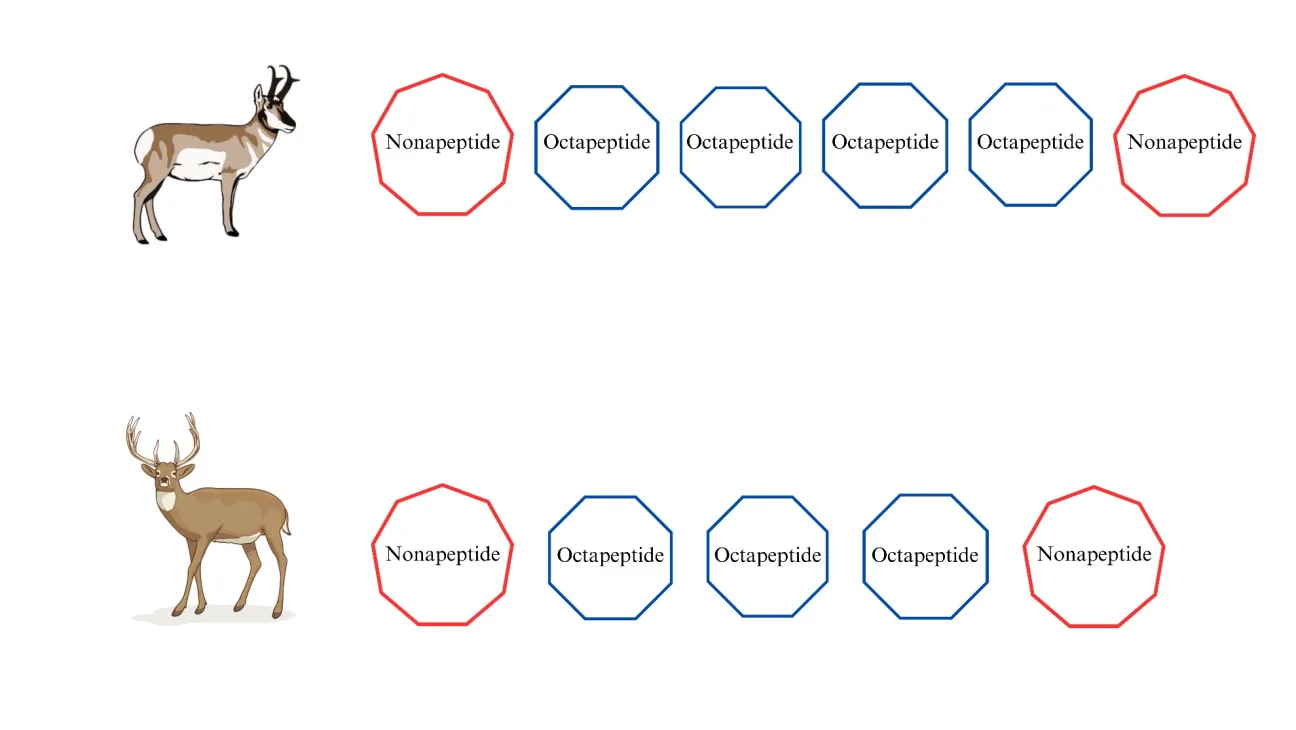
Figure 2. Visual representation of the differences in the number of repeats in pronghorn (top, 2 nonapeptide repeats and 4 octapeptide repeats for a total of 6 repeats) and Cervids (bottom, 2 nonapeptide repeats and 3 octapeptide repeats for a total of 5 repeats). Nonapeptide repeats contain the sequence P(H/Q)GGGGWG and octapeptide repeats contain the sequence PHGGGGWGQ.
Characterization of exon 3 of PRNP in pronghorn
Codons at loci 103, 104, 124, 132, 233, and 234 (cervid loci 95, 96, 116, 132, 225, and 226) in pronghorn were identical to consensus cervid amino acids at these loci (Robinson et al., 2012). Codons at pronghorn loci 108, 166, 297 (cervid loci 100, 158, and 289) matched the consensus cervid sequence rather than the consensus Bovid sequence. The presence of serine (S) at site 181 (cervid locus173) links pronghorn to bovids at this site, while cervids instead possess an asparagine (N). The primary observed difference between pronghorn and cervid PRNP sequences is the number of octapeptide repeats. At locus 56, pronghorn exhibited a nonapeptide repeat containing the amino acid sequence of PHGGGGWGQ followed by four octapeptide repeats containing the amino acid sequence of PHGGGWGQ and ending with the nonapeptide repeat at loci 106 (Figure 2).
Sequence comparison with ruminants
Pronghorn amino acid sequences of PRNP compared with sympatric, known CWD-susceptible cervids suggest that they are most similar to mule deer, particularly at locus 132 (methionine), and white-tailed deer. Elk possess a glutamic acid (E) at locus 226 (glutamic acid vs. glutamine in mule deer, pronghorn and white-tailed deer), where this substitution is reported to have limited biochemical distinction despite the change from acidic, electrically charged side chain (glutamic acid) to an uncharged, polar side chain (glutamine; Table 2). Comparisons with sheep and cattle revealed that at locus 173, pronghorn possess an S (serine) instead of an N (asparagine), matching cattle, and both amino acids are uncharged and hydrophilic. The molecular similarity between pronghorn and mule deer, combined with extensive ecological overlap, is consistent with mule deer representing a plausible source of exposure; however, transmission pathways remain speculative.
|
Locus |
Pronghorn |
Mule Deer |
White-tailed Deer |
Elk |
Cattle |
|---|---|---|---|---|---|
|
95 |
Q |
Q |
Q/H |
Q |
Q |
|
96 |
G |
G |
G/S |
G |
G |
|
116 |
A |
A |
A/G |
A |
A |
|
132 |
M |
M |
M |
M/L |
M |
|
173 |
S |
N |
N |
N |
S |
|
225 |
S |
S/F |
S |
S |
S |
|
226 |
Q |
Q |
Q |
E |
Q |
Phylogenetic analyses
Phylogenetic analyses yielded two clades (A and B), where Clade A consisted of known prion disease-susceptible Ruminants, while Clade B consisted of pronghorn and giraffe (Figure 3). Support for divergence of pronghorn (≥ 0.9 posterior probability, Huelsenbeck et al. 2002) from bovids, ovids, caprids and cervids with the DNA sequences was limited to Clade A. Despite limited support for internal structure within Clade B, pronghorn grouped as expected with giraffe, their most recent common ancestor (Figure 3, O’Gara and Yoakum 2004).
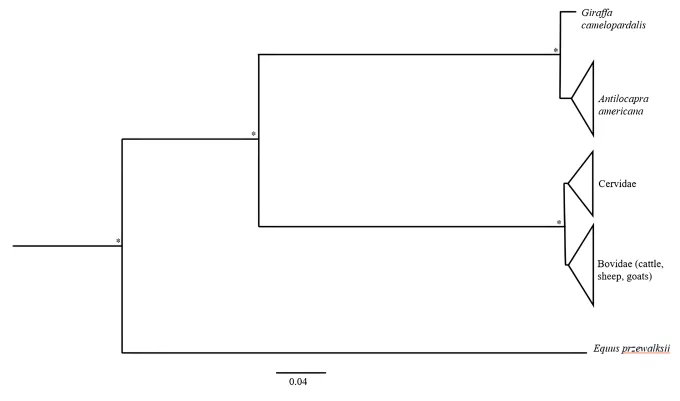
Figure 3. Phylogenetic tree from DNA sequences of the prion protein gene (PRNP) from suborder Ruminantia with Bayesian inference analyses (BEAST2 and BEAUTi2, Bouckaert et al. 2019). Nodal support is indicated by asterisks (*, ≥0.9 posterior probability, Huelsenbeck et al. 2002).
Discussion
The third exon of PRNP was successfully sequenced in pronghorn from Texas and New Mexico, and they share the same amino acid residues as Cervids at loci 95, 96, 116, 132, 225 and 226; and then possess an additional octapeptide repeat (Figures 2 and 3). These specific sites selected for comparison were based on the work of Robinson et al. (2012) who parsed out variability in PRNP genotypes of North American cervids and Buchholz et al. (2021) who characterized PRNP in axis deer (Axis axis) from the Texas Hill Country, as these have been previously linked to CWD susceptibility and resistance in cervids. No prior studies have explicitly identified these specific characteristics of PRNP in pronghorn. Pronghorn PRNP sequences occupy a genuinely intermediate position between cervid and bovid sequences by sharing characteristics with both lineages at key residues implicated in prion disease susceptibility. While cattle and pronghorn have identical residues at the sites of interest, pronghorn sympatry with mule deer, as well as their close similarity to mule deer at these residues may indicate that should pronghorn develop a prion disease like CWD, mule deer may be the origin (Table 2). This site-specific similarity to cervids at functionally relevant positions is the critical finding, and it persists despite whole-gene phylogenetic analyses placing pronghorn in Clade B, alongside giraffe. The discordance between phylogenetic placement and site-specific similarity underscores that taxonomic distance alone is not a reliable proxy for prion disease resistance, and that the assumption of pronghorn resistance based on family-level classification is not supported by these sequence data. The functional implications of these shared residues remain untested in pronghorn, but the molecular profile is inconsistent with confidently ruling out susceptibility.
Should pronghorn develop a prion disease, mule deer represent a plausible source of exposure given ecological overlap, and similarity of amino acids at the most common loci that correspond to susceptibility in mule deer if cross-species transmission were to occur (Table 2). Wyoming is considered the national stronghold for pronghorn (Jones et al., 2013) and does have high CWD prevalence in mule deer (Fisher et al., 2022; Robinson et al., 2012; Russell et al., 2026). For example, CWD prevalence rates in mule deer in Wyoming have been hovering around 30% since at least 2005, with some areas having a prevalence rate of up to 63% in male mule deer, while prevalence may be greater in sympatric areas with both elk and white-tailed deer (Fisher et al., 2022; Robinson et al., 2012; Russell et al., 2026). Pronghorn and mule deer are sympatric throughout their entire North American ranges, particularly in migration corridors, where they commonly forage in close proximity (Heffelfinger & Krausman, 2023; IUCN, 2016; Mysterud, 2023; O’Gara & Yoakum, 2004). The notion that pronghorn could develop their own prion disease remains untested, particularly under a scenario that could emerge from the quotidian overlap of their sympatric migration patterns.
The amino acid sequence of PrPC has been linked to intra- and interspecies transmission of, and susceptibility to, prion disease through the sequence similarity between an infected individual and a recipient (Angers et al., 2014; Arifin et al., 2021). Resistance to prion pathology can occur through PrPC amino acid sequence diversity among species, potentially at the familial level, and can reduce the probability of a conformational change of PrPC to the misfolded isoform, which has been described as a component of an interspecies barrier to prion transmission (Buchanan & Zink, 2021; Hill & Collinge, 2004; Mead, 2006; Prusiner, 1995). When considering the amino acid sites associated with resistance in deer, evolutionarily deer and bovines are equidistant from humans (Robinson et al., 2012). As bovine prions are known to subvert human PrPC as seen in BSE, then the same could be possible with cervid prions (Zink, 2020), as evolutionary distance alone may not provide enough evidence of, or exist as, a reliable species barrier (Zink et al., 2020). Other changes in amino acids at various loci are hypothesized to prevent different prion diseases in other species. For example, in domestic sheep, changes at locus 136 of alanine (A) to valine (V), locus 154 of arginine (R) to histidine (H) and at locus 171 of glutamine (Q) to either arginine or histidine, provide the molecular basis for genotypic resistance to scrapie (Hagenaars et al., 2018; Osterholm et al., 2019). Currently, in pronghorn, specific sequences of resistance or susceptibility using these PrP approaches remain unknown, but we have demonstrated there are similarities in molecular susceptibility to prion disease in pronghorn that align closely with mule deer.
PRNP genetics and evolution
Certain alleles and genotypes provide reduced susceptibility, to some degree, to various TSEs (Buchanan & Zink, 2021; Mead, 2006; Zink, 2020; Zink et al., 2020), and identification of the additional octapeptide repeat in pronghorn is unusual and previously unreported. This octapeptide repeat follows the amino acid sequence of PHGGGWGQ and most mammals are known to have three or four copies of this repeat (Figure 2; see van Rheede et al., 2003). Sheep, deer, and cattle have 3 tandem repeats of this octapeptide sequence while humans and pronghorn have 4 tandem repeats (Buchanan & Zink, 2021; Goldmann et al., 1998; Hagenaars et al., 2018; Puckett et al., 1991; Schätzl et al., 1995; van Rheede et al., 2003; Zink, 2020). While the number of repeats does not typically follow any phylogenetic pattern and is a frequent mutation in the Eutherian prion protein gene, balancing the number of repeats via selection can contribute to having too many repeats and therefore promoting the early onset of prion disease (Hagenaars et al., 2018). Variations in the number of repeats with the addition of 2-9 octarepeats in humans can result in an inherited prion disease (Puckett et al., 1991). Also, in goats, individuals with 3 repeats succumbed to prion disease after an unusually long incubation period (Schätzl et al., 1995). Neither humans nor pronghorn have known instances of contracting prion disease from a CWD-positive source (either environmentally or directly) which might be a potential indicator of a species barrier, however, variation in the number of octapeptide repeats seems to play little to no role in CWD expression in North American Cervids (Buchanan & Zink, 2021; Zink, 2020).
Fox et al. (2021) emphasizes the importance of publishing long-term surveillance data for pronghorn (if they exist) even in the absence of CWD-positive detections. Given the predicted potential susceptibility of pronghorn based on prion protein genetics, reporting negative surveillance results is critical to furthering management of CWD in all ungulate species. Reporting lack of detection in surveillance data for CWD and other diseases is arguably as important as reporting prevalence data, particularly if or when surveillance eventually reveals positive trends, and there are no baselines to refer to when developing epidemiological timelines and management actions. Such approaches provide clarity regarding lack of detection and tend to firmly support hypotheses examining either resistance or exposure risk, rather than perpetuating notions of resistance due to lack of published data or surveillance effort. As highlighted by the opportunistic surveillance efforts undertaken by Fox et al. (2021) in bighorn sheep (Ovis canadensis), the lack of detection should not be interpreted as evidence of resistance. Without systematic surveillance and reporting, even for negative, or non-detect tests for CWD and other prion diseases, we risk conflating non-detection with non-susceptibility, particularly when non-detection is due to lack of surveillance in the first place.
Regional and methodological distinctions from prior PRNP surveillance
While Cullingham et al. (2020) did sequence PRNP for pronghorn (n = 23, hair samples) they did so amidst a suite of other ruminants as part of a broader multi-species panel to assess susceptibility using both cyt-b and PRNP and all samples were sourced from wildlife in Alberta. Comparatively, the samples (n = 73) used in this study are from distinct, geographically and climatically separate populations in Texas and New Mexico. Both Texas and New Mexico each employ CWD management approaches distinct from Alberta’s and Texas specifically has had increasing and higher prevalence than Alberta’s ~9.7% (Alberta Environment & Protected Areas Ministry, 2026). Texas’ reported prevalence reflects a mix of captive and free-ranging surveillance under a different design than Alberta’s targeted WMU sampling, complicating direct comparison; nonetheless, free-ranging detections are concentrated in two primary foci, including the Texas Panhandle, indicating an actively expanding wild epizootic. Upon alignment, Cullingham et al. (2020) aligned PRNP sequences to human PRP, while our work specifically aligned our sequences to mule deer and followed the loci referencing system seen in Robinson et al. (2012) and Buchholz et al. (2021), a system that is already in use among wildlife managers, which makes these data interoperable with the applied CWD-management literature. The additional octarepeats we observed also were not reported in Cullingham et al. (2020) and pronghorn susceptibility to CWD in general and through the lens of PRNP genetics remains vastly underreported in the literature (Dominguez et al., 2025; Moazami-Goudarzi et al., 2021; Otero et al., 2021)
Potential species barrier
The potential species barrier is not well understood but could explain why pronghorn have not yet developed prion disease. While speculative, these mechanisms provide context for interpreting the absence of observed disease in pronghorn. With phylogenetically close species in which the difference in PrPCsequences is small, the barrier could manifest as an extension of the “incubation period” or time it takes for clinical disease to develop in an animal when that individual is inoculated with infectious material from a different species (Hamir et al., 2005). While pronghorn are dissimilar to elk at locus 132, where they possess a methionine (M) instead of a leucine (L), an extended latency period in which pronghorn might shed infectious prions without any clinical signs may be possible (O’Rourke et al., 2007). Pronghorn mortality factors estimate mean life expectancy for males is approximately 2.3 years, and nearly 4 years for females (O’Gara & Yoakum, 2004). As such, if this species barrier is dependent upon greater incubation duration prior to expression of clinical disease, it could be possible that pronghorn may not typically survive long enough for prion diseases to become pathogenic.
Experimental studies in other species demonstrate that differences in nucleotide or amino acid sequences could create a barrier to horizontal transmission by affecting incubation time (Buchanan & Zink, 2021; Escobar et al., 2020; Mead, 2006; Rongyan et al., 2008; Zink et al., 2020). An example of such a barrier existing would be the prion infectivity in some species and seemingly not others is an important characteristic when understanding the pathology of TSEs. Greenlee et al. (2012) successfully intracranially inoculated two out of fourteen cattle with CWD prions, highlighting that the development of clinical disease suggests that interfamilial transmission of infectious CWD prions is possible and provides the underpinning for a low-risk concern for transmission to pronghorn. Similarly, inoculations into Suffolk sheep which possessed three prion protein genotypes (ARR, ARQ and VRQ at the respective codons of 136, 154 and 171) with mule deer-sourced CWD prions yielded successful cross-species transmission (Clouscard et al., 1995). Such aggressive challenge studies are often viewed with skepticism relative to potential natural transfer, but they do provide foundational ‘proof of concept’ evidence, while simultaneously acknowledging transmission success is dependent upon host species genetics at those loci with respect to which allele is present (Greenlee et al., 2012; Hamir et al., 2006a; Hamir et al., 2006b). In terms of genetic susceptibility of CWD to an extended latency period, a study on the inoculation of elk calves identified a latency period between four- and six-years post-inoculation in elk who possessed the 132LL allele (O’Rourke et al., 2007). These individuals were sourced from an infected herd (located on a game farm in which at least 78 positive cases were identified) which may explain their longer incubation period (O’Rourke et al., 2007). The 132LL allele has also been implicated in various studies in elk as one that leads to reduced susceptibility and prolonged incubation time and is observed to have a frequency in the North American population of 37% (Morales, 2017; O’Rourke et al., 2007). Finally, Buchholz et al. (2021) reported that axis deer (Axis axis) could also be susceptible to CWD in a manner like elk using PRNP sequencing and highlighted the need for an expansion of surveillance to include axis deer, particularly in areas where they coexist with both native and non-native CWD-susceptible species. While pronghorn do not perfectly match the PRNP sequence of any species with confirmed prion disease susceptibility, the cumulative divergence at multiple functionally relevant positions raises questions about intermediate or novel risk. From a wildlife management perspective, the critical question is not whether pronghorn replicate a known susceptibility profile, but rather what risks are incurred by assuming they do not present one.
Strain typing for prion diseases
Research into the clinicopathological phenotypes of prion diseases has led to strain typing (Morales, 2017), which has provided evidence for the existence of 10 different CWD strains in North America (Otero et al., 2022). Differences among strains can occur through how PrPSc misfolds, changes in the incubation period, changes in clinical signs and changes in the lesion profile, and to date – little research has focused upon linking specific strains to previously identified genotypes that confer resistance or susceptibility. However, the increasing number of identified CWD strains should underscore the risks associated with rigid labeling of resistance (or susceptibility) as subtle differences in strains may negate the conferred molecular protection (or risks) associated with specific genotypes, particularly if novel strains emerge that challenge predetermined notions of species susceptibility (Otero et al., 2022). The apparent spontaneous development of exotic ungulate spongiform encephalopathy (EUSE) in the UK in 1994 [which was observed in kudu (Tragelaphus strepsiceros), eland (Taurotragus oryx), Arabian oryx (Oryx leucoryx), ankole cattle (Bos taurus indicus), gemsbok (Oryx gazella), nyala (Tragelaphus angasii), scimitar-horned oryx (Oryx dammah), and bison (Bison bison)] after consumption of feed containing ruminant-derived protein underscores the potential risk of (a) interspecies transmission, (b) rapid emergence of new prion strains, and (c) rapid expansion of susceptible species in genera and taxa that were previously considered resistant (Imran & Mahmood, 2011; Kirkwood & Cunningham, 1994).
The role of polymorphisms on strain variation has been described in several species, including in cervids with regard to CWD (Morales, 2017; Velásquez et al., 2020). Of the 10 identified CWD strains, half have been identified in lab species (e.g. hamsters, mice, voles) through intracranial inoculation rather than assumed natural transmission pathway(s) (Otero et al., 2022). Aside from dictating susceptibility to CWD, polymorphisms in PRNP can also modulate strain selection which can result in the emergence and adaptation of new strains (Hannaoui et al., 2017; Otero et al., 2022). Considering that pronghorn possess all the polymorphisms of PRNP that correspond with increased susceptibility to CWD, strain selection and adaptation of a CWD strain that specifically affects pronghorn seems to be the likely pathway if that eventually occurs. Specifically, pronghorn possess the mule deer polymorphism of locus 226, which has been documented to be the sole primary structural difference between deer and elk prion protein and functionally dictates the selection and propagation of different CWD strains (Bian et al., 2019; Hannaoui et al., 2017). Although large-scale feeding of ruminant-derived protein in regions where pronghorn exist is an unlikely pathway in which arrival of a new CWD strain would occur, the conceptual linkages between potential pronghorn susceptibility to the EUSE outbreak in the UK is that novel strains do emerge in which new taxa do become susceptible to prion disease (Kirkwood & Cunningham, 1994; Morales, 2017). Elevated vigilance and awareness relative to surveillance, containment, and management for prion disease in regions where there are sympatric ungulates, including pronghorn, and others that are currently considered resistant, may need to be considered part of periodic, regional assessments.


Acknowledgments
We thank Shawn Gray of Texas Parks and Wildlife Department and Tony Opatz of New Mexico Game and Fish Department for supplying samples for this project. This research was funded by the Rumsey Research and Development Fund and the Bricker Endowment for Wildlife Management within the Department of Natural Resources Management, Texas Tech University. Thank you to Peregrine Wolff for her invaluable insight, support and generosity in sharing both her knowledge and network, which significantly enhanced the quality and scope of our research. Special thanks to Ross McCauley and Steve Fenster of Fort Lewis College for their assistance with preparing sequences for uploading to GenBank.
Author Contributions
A.P. and M.B. conceived and planned the research. A.P. carried out the laboratory work and sequence analysis. A.P., M.B., C.R., M.J., and W.C. contributed to the interpretation of the results. A.P. took the lead in writing the manuscript. All authors provided critical feedback and helped shape the research, analysis and manuscript.
Data Availability
The data that support the findings of this research are available from the corresponding author upon reasonable request.
Transparent Peer Review
Results from the Transparent Peer Review can be found here.
Recommended Citation
Patrick, A. M., Conway, W. C., Buchholz, M. J., & Ramsey, C. L. (2026). Potential Pronghorn (Antilocapra americana) Susceptibility to Chronic Wasting Disease Through PRNP Sequencing. Stacks Journal: 26020. https://doi.org/10.60102/stacks-26020
Conflicts of Interest
No potential conflict of interest is reported by the authors.
Funding Information
This research was funded by the Rumsey Research and Development Fund and the Bricker Endowment for Wildlife Management within the Department of Natural Resources Management, Texas Tech University.
AI Use Statement
Copyright
© 2026 Angela M. Patrick, Warren C. Conway, Matthew J. Buchholz, & Courtney L. Ramsey. This article is open access and distributed under the terms and conditions of the Creative Commons Attribution (CC BY 4.0) license.
Supplementary Information
This paper is based on Chapter 1 of the author's Masters thesis: Patrick, A.M. 2023. Surveillance and prevalence of potential disease in pronghorn (Antilocapra americana) and mule deer (Odocoileus hemionus) in the Texas Panhandle. Thesis, Texas Tech University, Lubbock, TX.
References
Angers, R., Christiansen, J., Nalls, A. V., Kang, H.-E., Hunter, N., Hoover, E., Mathiason, C. K., Sheetz, M., & Telling, G. C. (2014). Structural effects of PrP polymorphisms on intra- and interspecies prion transmission. Proceedings of the National Academy of Sciences, 111(30), 11169–11174. https://doi.org/10.1073/pnas.1404739111
Arifin, M. I., Hannaoui, S., Chang, S. C., Thapa, S., Schatzl, H. M., & Gilch, S. (2021). Cervid prion polymorphism: role in chronic wasting disease pathogenesis. International Journal of Molecular Sciences, 22, 2271. https://doi.org/10.3390/ijms22052271
Baygents, G., & Bani-Yaghoub, M. (2018). Cluster analysis of hemorrhagic disease in Missouri’s white-tailed deer population: 1980–2013. BMC Ecology, 18(1). https://doi.org/10.1186/s12898-018-0188-6
Baylis, M., & Goldmann, W. (2004). The genetics of scrapie in sheep and goats. Current Molecular Medicine, 4(4), 385–396. https://doi.org/10.2174/1566524043360672
Bian, J., Christiansen, J. R., Moreno, J. A., Kane, S. J., Khaychuk, V., Gallegos, J., Kim, S., & Telling, G. C. (2019). Primary structural differences at residue 226 of deer and elk PrP dictate selection of distinct CWD prion strains in gene-targeted mice. Proceedings of the National Academy of Sciences, 116(25), 12478–12487. https://doi.org/10.1073/pnas.1903947116
Bouckaert, R., Vaughan, T. G., Barido-Sottani, J., Duchêne, S., Fourment, M., Gavryushkina, A., Heled, J., Jones, G., Kühnert, D., De Maio, N., Matschiner, M., Mendes, F. K., Müller, N. F., Ogilvie, H. A., du Plessis, L., Popinga, A., Rambaut, A., Rasmussen, D., Siveroni, I., … Drummond, A. J. (2019). BEAST 2.5: An advanced software platform for Bayesian evolutionary analysis. PLOS Computational Biology, 15(4), e1006650. https://doi.org/10.1371/journal.pcbi.1006650
Bouckaert, R. R. (2021). An efficient coalescent epoch model for Bayesian phylogenetic inference. https://doi.org/10.1101/2021.06.28.450225
Buchanan, B.L. and Zink, R.M. (2021). Evolution of transmissible spongiform encephalopathies and the prion protein gene (PRNP) in mammals. Journal of Mammalian Evolution 28:573-582. https://doi.org/10.1007/s10914-021-09557-6
Buchholz, M. J., Wright, E. A., Grisham, B. A., Bradley, R. D., Arsuffi, T. L., & Conway, W. C. (2021). Characterization of the prion protein gene in axis deer (Axis axis) and implications for susceptibility to chronic wasting disease. Prion, 15(1), 44–52. https://doi.org/10.1080/19336896.2021.1910177
Cain, J. W., Ashling, J. B., & Liley, S. G. (2018). Survival and cause-specific mortality of translocated female mule deer in southern New Mexico, USA. Wildlife Research, 45(4), 325–335. https://doi.org/10.1071/wr17173
Clouscard, C., Beaudry, P., Elsen, J. M., Milan, D., Dussaucy, M., Bounneau, C., Schelcher, F., Chatelain, J., Launay, J. M., & Laplanche, J. L. (1995). Different allelic effects of the codons 136 and 171 of the prion protein gene in sheep with natural scrapie. Journal of General Virology, 76(8), 2097–2101. https://doi.org/10.1099/0022-1317-76-8-2097
Conner, M. M., & Miller, M. W. (2004). Movement patterns and spatial epidemiology of A prion disease in mule deer population units. Ecological Applications, 14(6), 1870–1881. https://doi.org/10.1890/03-5309
Cullingham, C. I., Peery, R. M., Dao, A., McKenzie, D. I., & Coltman, D. W. (2020). Predicting the spread-risk potential of chronic wasting disease to sympatric ungulate species. Prion, 14(1), 56–66. https://doi.org/10.1080/19336896.2020.1720486
Der Sarkissian, C., Ermini, L., Schubert, M., Yang, M. A., Librado, P., Fumagalli, M., Jónsson, H., Bar-Gal, G. K., Albrechtsen, A., Vieira, F. G., Petersen, B., Ginolhac, A., Seguin-Orlando, A., Magnussen, K., Fages, A., Gamba, C., Lorente-Galdos, B., Polani, S., Steiner, C., … Orlando, L. (2015). Evolutionary genomics and conservation of the endangered Przewalski’s horse. Current Biology, 25(19), 2577–2583. https://doi.org/10.1016/j.cub.2015.08.032
Douglas, J., Zhang, R., & Bouckaert, R. (2021). Adaptive dating and fast proposals: Revisiting the phylogenetic relaxed clock model. PLOS Computational Biology, 17(2), e1008322. https://doi.org/10.1371/journal.pcbi.1008322
Dubay, S. A., Noon, T. H., deVos, J. C., & Ockenfels, R. A. (2006). Serologic survey for pathogens potentially affecting pronghorn (Antilocapra americana) fawn recruitment in Arizona, USA. Journal of Wildlife Diseases, 42(4), 844–848. https://doi.org/10.7589/0090-3558-42.4.844
Escobar, L. E., Pritzkow, S., Winter, S. N., Grear, D. A., Kirchgessner, M. S., Dominguez‐Villegas, E., Machado, G., Townsend Peterson, A., & Soto, C. (2020). The ecology of chronic wasting disease in wildlife. Biological Reviews, 95(2), 393–408. https://doi.org/10.1111/brv.12568
Fisher, M. C., Prioreschi, R. A., Wolfe, L. L., Runge, J. P., Griffin, K. A., Swanson, H. M., & Miller, M. W. (2022). Apparent stability masks underlying change in a mule deer herd with unmanaged chronic wasting disease. Communications Biology, 5(1). https://doi.org/10.1038/s42003-021-02951-z
French, J. T. (2015). Pronghorn diet, nutrition, and habitat assessment in Trans-Pecos, Texas. Thesis. Sul Ross State University. 140 pp.
Goldmann, W., Hunter, N., Chong, A., Foster, J., & Hope, J. (1998). The shortest known prion protein gene allele occurs in goats, has only three octapeptide repeats and is non-pathogenic. Journal of General Virology, 79(12), 3173–3176. https://doi.org/10.1099/0022-1317-79-12-3173
Greenlee, J. J., Nicholson, E. M., Smith, J. D., Kunkle, R. A., & Hamir, A. N. (2012). Susceptibility of cattle to the agent of chronic wasting disease from elk after intracranial inoculation. Journal of Veterinary Diagnostic Investigation, 24(6), 1087–1093. https://doi.org/10.1177/1040638712461249
Hagenaars, T. J., Melchior, M. B., Windig, J. J., Bossers, A., Davidse, A., & van Zijderveld, F. G. (2018). Modelling of strategies for genetic control of scrapie in sheep: The importance of population structure. PLOS ONE, 13(3), e0195009. https://doi.org/10.1371/journal.pone.0195009
Hamir, A. N., Gidlewski, T., Spraker, T. R., Miller, J. M., Creekmore, L., Crocheck, M., Cline, T., & O'Rourke, K. I. (2006). Preliminary observations of genetic susceptibility of elk (Cervus elaphus nelsoni) to chronic wasting disease by experimental oral inoculation. Journal of Veterinary Diagnostic Investigation, 18(1), 110–114. https://doi.org/10.1177/104063870601800118
Hamir, A. N., Kunkle, R. A., Cutlip, R. C., Miller, J. M., O'Rourke, K. I., Williams, E. S., Miller, M. W., Stack, M. J., Chaplin, M. J., & Richt, J. A. (2005). Experimental transmission of chronic wasting disease agent from mule deer to cattle by the intracerebral route. Journal of Veterinary Diagnostic Investigation, 17(3), 276–281. https://doi.org/10.1177/104063870501700313
Hamir, A. N., Kunkle, R. A., Cutlip, R. C., Miller, J. M., Williams, E. S., & Richt, J. A. (2006). Transmission of chronic wasting disease of mule deer to Suffolk sheep following intracerebral inoculation. Journal of Veterinary Diagnostic Investigation, 18(6), 558–565. https://doi.org/10.1177/104063870601800606
Hannaoui, S., Amidian, S., Cheng, Y. C., Duque Velásquez, C., Dorosh, L., Law, S., Telling, G., Stepanova, M., McKenzie, D., Wille, H., & Gilch, S. (2017). Destabilizing polymorphism in cervid prion protein hydrophobic core determines prion conformation and conversion efficiency. PLOS Pathogens, 13(8), e1006553. https://doi.org/10.1371/journal.ppat.1006553
Heffelfinger, J. R., & Krausman, P. R. (2023). Ecology and management of black-tailed and mule deer of north america. https://doi.org/10.1201/9781003354628
Hill, A., & Collinge, J. (2004). Prion strains and species barriers. In Contributions to Microbiology (pp. 33–49). KARGER. https://doi.org/10.1159/000077061
Huelsenbeck, J. P., Larget, B., Miller, R. E., & Ronquist, F. (2002). Potential applications and pitfalls of Bayesian inference of phylogeny. Systematic Biology, 51(5), 673–688. https://doi.org/10.1080/10635150290102366
Imran, M., & Mahmood, S. (2011). An overview of animal prion diseases. Virology Journal, 8(1). https://doi.org/10.1186/1743-422x-8-493
IUCN SSC Antelope Specialist Group. (2016). Antilocapra americana. The IUCN Red List of Threatened Species. https://doi.org/10.2305/IUCN.UK.2016-3.RLTS.T1677A50181848.en. Accessed April 2021.
Jewell, J. E., Brown, J., Kreeger, T., & Williams, E. S. (2006). Prion protein in cardiac muscle of elk (Cervus elaphus nelsoni) and white-tailed deer (Odocoileus virginianus) infected with chronic wasting disease. Journal of General Virology, 87(11), 3443–3450. https://doi.org/10.1099/vir.0.81777-0
Jones, P. F., Reinking, A. K., Jakes, A. F., Miller, M. M., Creekmore, T., & Guenzel, R. (2023). Chapter 19 in L.B. McNew, D.K. Dahlgren, J.L. Beck, editors. Rangeland Wildlife Ecology and Conservation. Springer Nature Switzerland, Cham Switzerland, 1017 pp.
Kalyaanamoorthy, S., Minh, B. Q., Wong, T. K. F., von Haeseler, A., & Jermiin, L. S. (2017). ModelFinder: fast model selection for accurate phylogenetic estimates. Nature Methods, 14(6), 587–589. https://doi.org/10.1038/nmeth.4285
Kirkwood, J., & Cunningham, A. (1994). Epidemiological observations on spongiform encephalopathies in captive wild animals in the British Isles. Veterinary Record, 135(13), 296–303. https://doi.org/10.1136/vr.135.13.296
Kumar, S., Stecher, G., Li, M., Knyaz, C., & Tamura, K. (2018). MEGA X: Molecular evolutionary genetics analysis across computing platforms. Molecular Biology and Evolution, 35(6), 1547–1549. https://doi.org/10.1093/molbev/msy096
Lanave, C., Preparata, G., Sacone, C., & Serio, G. (1984). A new method for calculating evolutionary substitution rates. Journal of Molecular Evolution, 20(1), 86–93. https://doi.org/10.1007/bf02101990
McCabe, R. E., O’Gara, B. W., & Reeves, H. M. (2004). Prairie ghost: pronghorn and human interaction in early America. University Press, Boulder, Colorado, USA, 388 pp.
Mead, S. (2006). Prion disease genetics. European Journal of Human Genetics, 14(3), 273–281. https://doi.org/10.1038/sj.ejhg.5201544
Morales, R. (2017). Prion strains in mammals: Different conformations leading to disease. PLOS Pathogens, 13(7), e1006323. https://doi.org/10.1371/journal.ppat.1006323
Mysterud, A. (2023). An epidemiological framework for chronic wasting disease in multihost communities. Journal of Applied Ecology, 60(8), 1545–1550. https://doi.org/10.1111/1365-2664.14441
O’Gara, B. W., & Yoakum, J. D. (2004). Pronghorn: ecology and management. University Press of Colorado, Boulder, Colorado, 948 pp.
O'Rourke, K. I., Spraker, T. R., Zhuang, D., Greenlee, J. J., Gidlewski, T. E., & Hamir, A. N. (2007). Elk with a long incubation prion disease phenotype have a unique PrPd profile. NeuroReport, 18(18), 1935–1938. https://doi.org/10.1097/wnr.0b013e3282f1ca2f
Osterholm, M. T., Anderson, C. J., Zabel, M. D., Scheftel, J. M., Moore, K. A., & Appleby, B. S. (2019). Chronic wasting disease in Cervids: Implications for prion transmission to humans and other animal species. mBio, 10(4). https://doi.org/10.1128/mbio.01091-19
Otero, A., Duque Velasquez, C., McKenzie, D., & Aiken, J. (2023). Emergence of CWD strains. Cell and Tissue Research, 392(1), 135–148. https://doi.org/10.1007/s00441-022-03688-9
Patrick, A. M. (2023). Surveillance and prevalence of potential disease in pronghorn (Antilocapra americana) and mule deer (Odocoileus hemionus) in the Texas Panhandle. Thesis, Texas Tech University, Lubbock, TX, 98 pp.
Prusiner, S. B. (1995). The prion diseases. Scientific American, 272(1), 48–57. https://doi.org/10.1038/scientificamerican0195-48
Puckett, C., Concannon, P., Casey, C., & Hood, L. (1991). Genomic structure of the human prion protein gene. American Journal of Human Genetics, 49, 320–329.
Richards, B. J. (2021). Chronic Wasting Disease distribution in the United States by state and county (ver. 3.0, June 2025). U.S. Geological Survey data release, https://doi.org/10.5066/P9HQKKFO
Robinson, S. J., Samuel, M. D., O'Rourke, K. I., & Johnson, C. J. (2012). The role of genetics in chronic wasting disease of North American cervids. Prion, 6(2), 153–162. https://doi.org/10.4161/pri.19640
Rodríguez, F., Oliver, J., Marín, A., & Medina, J. (1990). The general stochastic model of nucleotide substitution. Journal of Theoretical Biology, 142(4), 485–501. https://doi.org/10.1016/s0022-5193(05)80104-3
Rongyan, Z., Xianglong, L., Lanhui, L., Xiangyun, L., & Fujun, F. (2008). Evolution and differentiation of the prion protein gene (PRNP) among species. Journal of Heredity, 99(6), 647–652. https://doi.org/10.1093/jhered/esn073
Russell, T. I., Cross, P. C., Dugovich, B. S., Tomaszewski, E. M., Lawson, A. R. J., Lutz, D. W., Gregory, Z. W., Hnilicka, P. A., Tennant, J. M., Parrie, L. E., Allen, S. A., Merkle, J. A., & Malmberg, J. L. (2026). Chronic wasting disease reduces mule deer survival and hunter success in the Wind River Basin of Wyoming. From the Field Elevating Indigenous Voices, 1, 41–60.
Saiki, R., Gyllensten, U. & Erlich, H. (1988). Polymerase chain reaction. Science, 239(4839), 487.
Sawyer, H., Lindzey, F., & McWhirter, D. (2005). Mule deer and pronghorn migration in western Wyoming. Wildlife Society Bulletin, 33(4), 1266–1273. https://doi.org/10.2193/0091-7648(2005)33[1266:mdapmi]2.0.co;2
Sawyer, H., Rodgers, P. A., & Hart, T. (2016). Pronghorn and mule deer use of underpasses and overpasses along U.S. Highway 191. Wildlife Society Bulletin, 40(2), 211–216. https://doi.org/10.1002/wsb.650
Schätzl, H. M., Costa, M. D., Taylor, L., Cohen, F. E., & Prusiner, S. B. (1995). Prion protein gene variation among primates. Journal of Molecular Biology, 245(4), 362–374. https://doi.org/10.1006/jmbi.1994.0030
Seton, E. T. (1909). Life-histories of northern animals an account of the mammals of Manitoba /. https://doi.org/10.5962/bhl.title.68294
Simpson, D.C., L.A. Harveson, C.E. Brewer, R.E. Walser, and A.R Sides. 2007. Influence of precipitation on pronghorn demography in Texas. Journal of Wildlife Management 71:906-910.
Texas Parks and Wildlife Department. (2024). CWD Zones and Check Stations. https://tpwd.texas.gov/huntwild/wild/diseases/cwd/maps/cwd-zones-check-stations.phtml, Accessed December 2024.
Thorne, E. T., Williams, E. S., Spraker, T. R., Helms, W., & Segerstrom, T. (1988). Bluetongue in free-ranging pronghorn antelope (Antilocapra americana) in Wyoming: 1976 and 1984. Journal of Wildlife Diseases, 24(1), 113–119. https://doi.org/10.7589/0090-3558-24.1.113
Trifinopoulos, J., Nguyen, L.-T., von Haeseler, A., & Minh, B. Q. (2016). W-IQ-TREE: a fast online phylogenetic tool for maximum likelihood analysis. Nucleic Acids Research, 44(W1), W232-W235. https://doi.org/10.1093/nar/gkw256
U.S. Geological Survey (USGS) - Gap Analysis Project (GAP). 2018. Pronghorn (Antilocapra americana) mPRONx_CONUS-2001v1 Habitat Map. USGS data release.
USGS National Wildlife Health Center. (2025). Distribution of Chronic Wasting Disease in North America. https://www.usgs.gov/centers/nwhc/science/expanding-distribution-chronic-wasting-disease, Accessed January 2025.
van Rheede, T., Smolenaars, M. M. W., Madsen, O., & de Jong, W. W. (2003). Molecular Evolution of the mammalian prion protein. Molecular Biology and Evolution, 20(1), 111–121. https://doi.org/10.1093/molbev/msg014
Velásquez, C. D., Kim, C., Haldiman, T., Kim, C., Herbst, A., Aiken, J., Safar, J. G., & McKenzie, D. (2020). Chronic wasting disease (CWD) prion strains evolve via adaptive diversification of conformers in hosts expressing prion protein polymorphisms. Journal of Biological Chemistry, 295, 4985–5001.
Weaver, J. H. (2013). The role of parasites, diseases, mineral levels and low fawn survival in a declining pronghorn population in the Trans-Pecos region of Texas. Thesis, Sul Ross State University, Alpine, TX, 107 pp.
White, P. J., Gower, C. N., Davis, T. L., Sheldon, J. W., & White, J. R. (2012). Group dynamics of Yellowstone pronghorn. Journal of Mammalogy, 93(4), 1129–1138. https://doi.org/10.1644/10-mamm-a-257.1
Zink, R. M. (2020). Genetic and evolutionary considerations of the Chronic Wasting Disease – Human species barrier. Infection, Genetics and Evolution, 84, 104484. https://doi.org/10.1016/j.meegid.2020.104484
Zink, R. M., Najar, N., Vázquez-Miranda, H., Buchanan, B. L., Loy, D., & Brodersen, B. W. (2020). Geographic variation in the PRNP gene and its promoter, and their relationship to chronic wasting disease in North American deer. Prion, 14(1), 185–192. https://doi.org/10.1080/19336896.2020.1796250