Preparing Teachers: Cognitive Learning Strategies in Teacher Education Programs
CollaboratorsReviewers can opt-in to be listed as a Collaborator on the manuscript as recognition for their contributions.: Eva Straub & Sonya Sharififard
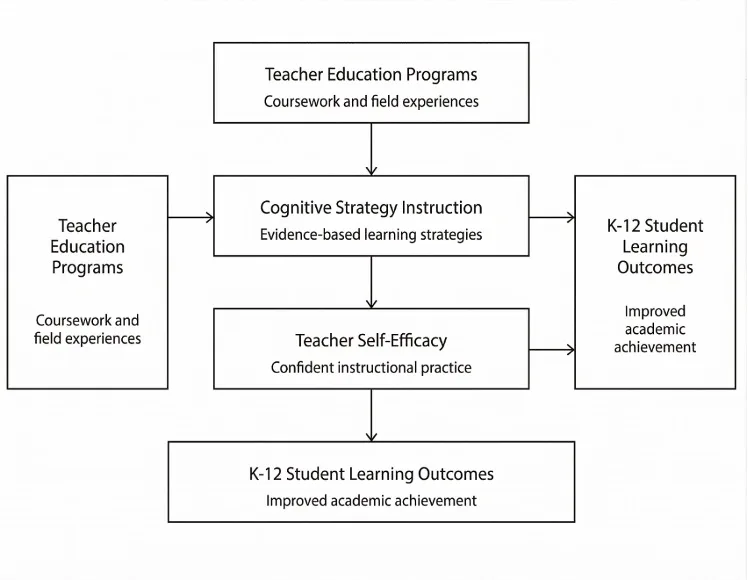
Abstract photo. Conceptual framework illustrating the integration of cognitive learning strategies within teacher education to enhance K-12 student success.
Abstract
Teacher education programs are tasked with the critical work of preparing educators to teach K-12 students content area knowledge and skills. Equipping these candidates with instructional strategies backed by decades of cognitive research before they enter the classroom is one route to ultimately foster student learning. This paper explores the experiences of 12 Western U.S. graduates regarding cognitive learning strategy instruction using a hermeneutic phenomenological study. Data collected through surveys, interviews, and a focus group led to the identification of themes about program instruction, common misunderstandings of cognitive science, and teacher readiness. Findings indicate limited integration across programs, creating a "theory-practice" gap where new teachers rely on intuition over scientific principles. These results highlight areas for improvement in supporting student learning outcomes.
Keywords: teacher education, cognitive learning strategies, teacher preparation, preservice teacher, credential, learning science, pedagogy
Introduction
Teacher education programs are primarily responsible for giving future educators the knowledge and teaching skills they need to effectively help K-12 students. In recent decades, however, the teaching profession has faced growing public criticism and a loss of trust, largely due to continuously declining test scores and concerns about unmet educational needs. Research-backed cognitive learning strategies, which have been proven effective across brain science and educational studies, are a promising way to improve teaching practices and, therefore, student outcomes (Agarwal et al., 2014; Agarwal & Roediger, 2018; Madan, 2023). Despite these clear benefits, serious debate continues about the priorities and focus of teacher training programs, even as student achievement in key subjects such as reading and mathematics continues to decline.
Even with the growing evidence supporting their effectiveness, cognitive learning strategies are still not regularly included in teacher education classes (Cuevas et al., 2023). Research suggests that teachers with better basic knowledge of how students learn are better at teaching, especially for tasks that require deep critical thinking (Darling-Hammond, 2023). The results of this teaching gap are significant; cognitive learning strategies have been linked to clear improvements in language learning, math skills, and reading ability (Barbieri et al., 2020; Weinstein & Acee, 2018). Their absence has been linked with lower grades, less student confidence, and higher school-related stress.
Teacher readiness, also, is one of the strongest signs of both teacher effectiveness and student learning success. While existing research has focused heavily on student teaching and coursework, a clear gap remains regarding graduates’ views, specifically, how teachers use cognitive learning strategies within the realities of their own classrooms after finishing their program. This study addresses that gap by providing first-hand data on how teachers use these strategies on the job, with the aim of improving lessons that may better strengthen teacher preparation and finally improve classroom results.
Methods and Materials
Research design and participants
In this study, a qualitative, hermeneutic phenomenological approach was used to explore the lived experiences of recent teacher education graduates (Creswell & Poth, 2018; Kircher, 2024; Van Manen, 1990). This was the research approach for this study because the researcher shared many of the same experiences with the phenomenon as the participants, using their experience as both a graduate and a current instructor to guide the interpretation of the phenomenon (Van Manen, 1990). This approach emphasizes understanding the essence of experiences through an interrelationship of one’s description of their experience and the underlying dynamics that account for that experience (Husserl, 1970) The study included 12 recent graduates from three universities in the Western United States, including a large state university, an online non-profit institution, and a for-profit urban institution. All participants had graduated within the last one to five years and taught in K-12 schools across a range of subject areas, including Visual Art, Mathematics, and the Humanities.
Data collection and analysis
Research followed a multi-phase sequential design, moving from broad surveys to 30-to-60-minute interviews done via Zoom, and ending in a one-hour focus group (Creswell & Poth, 2018). This order was on purpose, helping data triangulation by moving step-by-step from broad trends toward more specific and detailed discussion (Creswell & Poth, 2018). Data were then analyzed through a mix of thematic analysis and pattern coding (Kiger & Varpio, 2020; Saldana, 2021). NVivo software was used to find and organize common patterns in how participants viewed their training and how they used cognitive strategies at work. University review board approvals were obtained before starting to ensure that all ethical standards were followed throughout the research study.
Results
Program incorporation of strategies
Of the 12 participants, 10 said they were taught cognitive learning strategies, though the amount varied. Strategies were mostly included through textbooks and assignments. Specifically, Vivian observed that reference books improved her understanding, while Taylor stressed learning by doing. However, this was limited; Julie felt the instruction “wasn’t as connected” to her specific subject, and Grace remarked it was only found in “early development” courses. Six participants said they needed more instruction, feeling not ready to support students with reading difficulties or older struggling students. Participants wanted these strategies to be “embedded into every course” and included in the coaching models during student teaching.
The reality of misunderstandings
A distinct finding was that 11 out of 12 participants had misconceptions about cognitive learning strategies. Many thought common teaching practices or “neuromyths”, like learning styles, were cognitive strategies. George maintained that specific examples like retrieval practice were never clearly described in his program. Rebecca mistakenly called “multiple ways to express knowledge” (image-making, dialogue) cognitive learning strategies. If a tool seemed successful in class, participants were likely to label it a cognitive strategy no matter its scientific basis. Bryce felt that strategies might have been taught but were never specifically named.
Preparation and post-graduation support
Participants felt unready for classroom management and handling different learning needs in large classes. Julie found it hard to deal with diverse experiences due to large class sizes. Beyond that, seven participants wanted support after their programs ended, looking for handbooks or community networks to handle classroom problems. Laura noted that while she learned about the strategies, they did not help her teaching because they seemed designed for small class sizes with extra help.
Discussion
The knowledge gap and dunning-kruger effect
The varied views reported among graduates suggest that while coursework and fieldwork are key parts of teacher preparation, education programs still fail to provide enough background in cognitive strategies as a clear area of practice (Cuevas et al., 2023). The confusion between cognitive strategies and other teaching methods may come from the Dunning-Kruger effect, a situation where individuals stay highly confident in their skills despite knowing little about a specific topic (Dunlosky & Metcalfe, 2009). Most participants seemed to depend on intuition and personal stories rather than brain-based or proven models to guide how they teach. These findings highlight a major gap in teacher education programs, specifically the split between cognitive science and classroom teaching, and show a need for more organized work to fix this gap within teacher training.
Structural barriers and future directions
Programs face natural conflicts between tough coursework and heavy fieldwork, where high-stakes assessments like the CalTPA risk acting as costly distractions from meaningful learning (Lambert, 2024). Program improvements might include better use of neuroscience content and ensuring that university teaching and learning centers have real expertise in learning science. Where it makes sense, faculty could replace individual course offerings with action research, enabling immediate evaluation of teaching strategies in actual contexts. Purposeful mentorship that includes cognitive learning strategy instruction remains vital to long-term teacher effectiveness (Hairon et al., 2020; Hobson et al. 2009). Future research should further investigate whether these gaps are more common within specific content areas or grade levels.
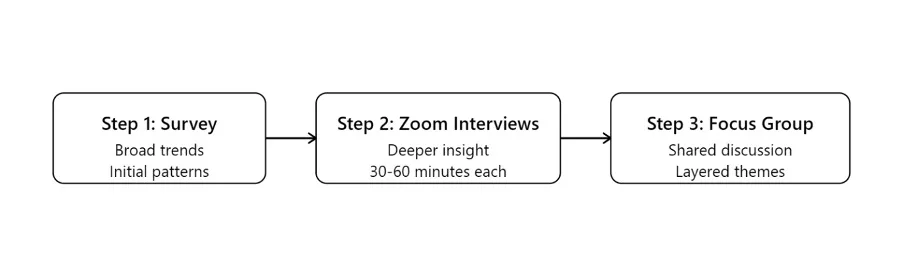
Figure 1. Data Collection Sequence. The multi-phase qualitative approach moved from broad survey data to specific focus group discussions to ensure data triangulation.
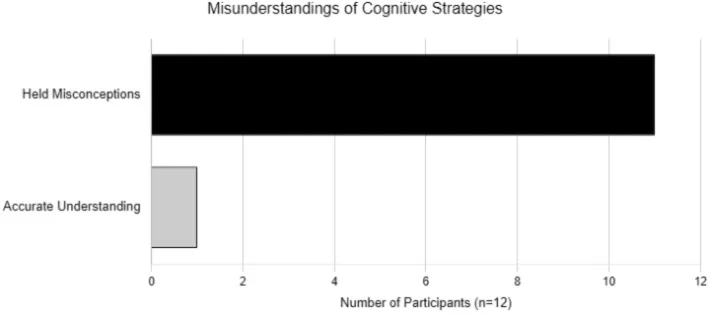
Figure 2. Participant Misunderstandings. Nearly all participants confused general pedagogical tools or neuromyths with cognitive learning strategies.
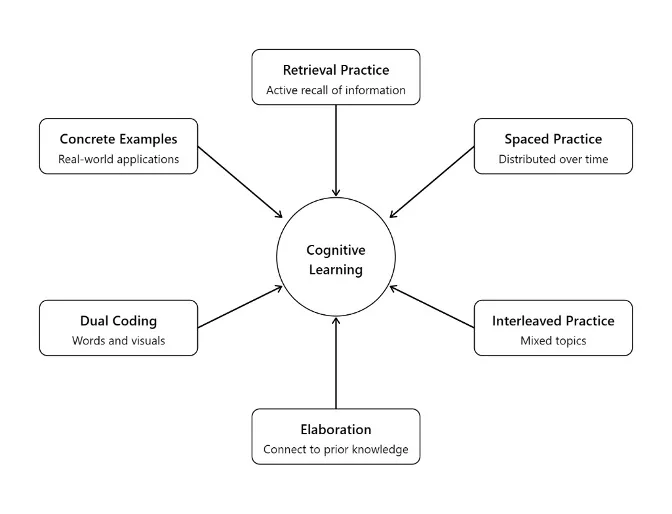
Figure 3. Effective Cognitive Strategies. These six strategies are recognized in the literature but were inconsistently recognized by participants.
|
Pseudonym |
Years Taught |
Gender |
Grade Level |
Content Area |
|---|---|---|---|---|
|
Julie |
1 |
Female |
High School |
Visual Art |
|
Grace |
5 |
Female |
High School |
Visual Art |
|
Bryce |
3 |
Male |
High School |
Visual Art |
|
Kevin |
1 |
Male |
High School |
Math |
|
Alice |
1 |
Female |
High School |
Social Sciences |
|
Nora |
1 |
Female |
High School |
Social Sciences |
|
Rebecca |
1 |
Female |
High School |
Social Sciences |
|
Laura |
1 |
Female |
High School |
World Languages |
|
Vivian |
1 |
Female |
High School |
World Languages |
|
Taylor |
1 |
Female |
K-12 |
Music |
|
Loren |
2 |
Female |
Middle School |
Visual Art |
|
George |
1 |
Male |
Middle School |
Humanities |


Acknowledgments
The author wishes to thank the 12 educators who took part in this study for freely sharing their work experiences and thoughts on teacher preparation. Thanks are also given to the involved universities in the Western U.S., without whose help this research would not have been possible. The ideas given by these recent graduates offer a vital look at the link between cognitive science and classroom teaching. The author thanks Christine Keith for providing helpful editorial and language assistance.
Author Contributions
Nicole Kircher: Conceptualization, Methodology, Formal Analysis, Investigation, Writing – Original Draft, Writing – Review & Editing.
Data Availability
Data is publicly available here: Kircher, Nicole (2024). Themes, Subthemes, Codes.xlsx. figshare. Dataset. https://doi.org/10.6084/m9.figshare.29104769.v1
Transparent Peer Review
Results from the Transparent Peer Review can be found here.
Recommended Citation
Kircher, N. (2026). Preparing Teachers: Cognitive Learning Strategies in Teacher Education Programs. Stacks Journal: 26015. https://doi.org/10.60102/stacks-26015
Conflicts of Interest
The author declares no conflicts of interest.
Funding Information
The author received no financial support for the research, authorship, and publication of this article.
AI Use Statement
Copyright
© 2026 Nicole Kircher. This article is open access and distributed under the terms and conditions of the Creative Commons Attribution (CC BY 4.0) license.
References
Agarwal, P. K., D'Antonio, L., Roediger, H. L., McDermott, K. B., & McDaniel, M. A. (2014). Classroom-based programs of retrieval practice reduce middle school and high school students’ test anxiety. Journal of Applied Research in Memory and Cognition, 3(3), 131–139. https://doi.org/10.1016/j.jarmac.2014.07.002
Agarwal, P. K., & Roediger, H. L. (2018). Lessons for learning: How cognitive psychology informs classroom practice. Phi Delta Kappan, 100(4), 8–12. https://doi.org/10.1177/0031721718815666
Barbieri, C. A., Rodrigues, J., Dyson, N., & Jordan, N. C. (2020). Improving fraction understanding in sixth graders with mathematics difficulties: Effects of a number line approach combined with cognitive learning strategies. Journal of Educational Psychology, 112(3), 628–648. https://doi.org/10.1037/edu0000384
Creswell, J. W., & Poth, C. N. (2018). Qualitative Inquiry and Research Design: Choosing Among Five Approaches. SAGE Publications.
Cuevas, J. A., Childers, G., & Dawson, B. L. (2023). A rationale for promoting cognitive science in teacher education: Deconstructing prevailing learning myths and advancing research-based practices. Trends in Neuroscience and Education, 33, 100209. https://doi.org/10.1016/j.tine.2023.100209
Darling-Hammond, L. (2023). Reprint: How teacher education matters. Journal of Teacher Education, 74(2), 151–156. https://doi.org/10.1177/00224871231161863
Dunlosky, J., & Metcalfe, J. (2009). Metacognition. SAGE Publications.
Hairon, S., Loh, S. H., Lim, S. P., Govindani, S. N., Tan, J. K. T., & Tay, E. C. J. (2020). Structured mentoring: Principles for effective mentoring. Educational Research for Policy and Practice, 19(2), 105–123. https://doi.org/10.1007/s10671-019-09251-8
Hobson, A. J., Ashby, P., Malderez, A., & Tomlinson, P. D. (2009). Mentoring beginning teachers: What we know and what we don't. Teaching and Teacher Education, 25(1), 207–216. https://doi.org/10.1016/j.tate.2008.09.001
Husserl, E. (1970). The crisis of European sciences and transcendental phenomenology: An introduction to phenomenological philosophy (D. Carr, Ed. & Trans.). Northwestern University Press.
Kiger, M. E., & Varpio, L. (2020). Thematic analysis of qualitative data: AMEE Guide No. 131. Medical Teacher, 42(8), 846–854. https://doi.org/10.1080/0142159x.2020.1755030
Kircher, N. (2024). Cognitive learning strategies and candidates in teacher education programs: A phenomenology[Doctoral dissertation, Liberty University]. Scholars Crossing. https://digitalcommons.liberty.edu/doctoral/6246
Lambert, D. (2024, April 19). California moves a step closer to eliminating one of the state’s last teacher assessments. EdSource. https://edsource.org/2024/california-moves-a-step-closer-to-eliminating-one-of-the-states-last-teacher-assessments/710227
Madan, C. R. (2023). Using evidence-based learning strategies to improve medical education. Medical Science Educator, 33(3), 773–776. https://doi.org/10.1007/s40670-023-01798-9
Saldana, J. (2021). The Coding Manual for Qualitative Researchers. SAGE.
Van Manen, M. (1990). Researching Lived Experience: Human Science for an Action Sensitive Pedagogy. State University of New York Press.
Weinstein, C. E., & Acee, T. W. (2018). Study and learning strategies. In R. F. Flippo & T. W. Bean (Eds.), Handbook of College Reading and Study Strategy Research (pp. 227–240). Routledge. https://doi.org/10.4324/9781315629810-17